Tag Archives: marketsmuse

Frmr NYSE Capo Niederauer Backs Bitcoin-based ‘smart securities’ startup Symbiont

Tech Talk: Bitcoin’s Distributed Ledgers: A FinTech Innovation..

MarketsMuse Trading Technology/FinTech department profiles Wall Street’s rapid embracement of the tools that power Bitcoin with a look at Symbiont, a company that aspires to disrupt the capital markets process.

Distributed ledgers, the technology behind the Bitcoin blockchain, can be used to issue, trade and process an array of financial instruments on a single, global, decentralized peer-to-peer financial network. And guess what, Symbiont, a startup that’s backed by several high-powered Wall Street figures, has established a platform for so-called smart securities, or financial assets that are programmable versions of traditional securities, using the distributed ledger.

Early investors include Duncan Niederauer, former CEO of NYSE Euronext, and Matt Andresen, founder of the Island ECN. “Symbiont is bridging the gap between Wall Street and the emerging blockchain ecosystem,” said Niederauer, managing member of 555 Capital and a member of the Symbiont Board of Directors.”It’s an exciting, timely and much-needed development for the long-term health of the markets.”

Neil DeSena, Senahill Partners

SenaHill Partners, the recently-established fintech merchant bank led by former Goldman Sachs trading tech honcho Neil DeSena and former Citigroup tech titan Justin Brownhill will serve as Symbiont’s business development agent. “SenaHill Partners is focused on fintech companies, and specifically on assisting a transition from analog-based financial services into technology-based financial services,” Smith said. “All of our access into the Street comes through SenaHill, so SenaHill is an important part of the Symbiont story.” SenaHill Partners also served as merchant bank and deal advisor to Livevol, the provider of equity and index options technology and market data services. During the first week of June, Livevol entered into a definitive agreement to be acquired by options exchange CBOE Holdings, Inc.

“The real value of this new technology is in the underlying protocol, the distributed nature of the Bitcoin blockchain, and the immutable nature of its ledger,” says Symbiont CEO Mark Smith. The distributed ledger is “a way to create new securities that could solve some of the problems that existed in the more opaque, less transparent, less liquid markets,” Smith said.

“We have launched Symbiont to create a generic platform that can operate on multiple types of cryptographically protected distributed ledgers to create what we are trade marking Smart Securities,” said Smith. “It’s a digital security that can be programmed with all the terms and conditions of a financial instrument. Once issued on a block chain, it can act autonomously to execute and extract terms and corporate actions without any human intervention.”

MarketsMuse sends a shout-out and thumbs up to June 18 reporting of this story by MarketsMedia.com

State Street Loses Lead in ETFs; Moves On to Hedge Funds

MarketsMuse updates that State Street Corp., which lost its lead in exchange-traded funds after being a pioneer in the business more than two decades ago, is now betting on hedge funds.

The firm is expanding hedge funds and alternative investment strategies that can be offered to individual investors, Ronald O’Hanley, who in April replaced Scott Powers as head of the $2.45 trillion State Street Global Advisors, said in an interview from Boston. The money-management unit this month named Michael Ho to a newly-created role of chief investment officer for alternatives.

Ho, who heads active emerging market stock investing for State Street Corp.’s asset-management arm, will lead the unit’s expansion into these alternatives.

Last month, State Street Global Advisors named Ho to the newly created position of chief investment officer for alternatives, confirmed Brendan Paul, a spokesman for the Boston-based bank.

State Street is seeking to expand its asset management business as its active strategies — which command higher fees — have shrunk, and passive strategies such as ETFs have lost ground to BlackRock Inc. and Vanguard Group.

SEC Has Eye On ETFs

MarketsMuse ETF update profiles the inevitable: The U.S. Securities & Exchange Commission (SEC) now has their cross-hairs on the exchange-traded fund industry.

 As reported by Traders Magazine (among others), the Securities and Exchange Commission announced that it is seeking public comment to help inform its review of the listing and trading of new, novel, or complex exchange-traded products (ETPs).

 “Exchange-traded products have become an increasingly important investment vehicle to market participants ranging from individuals to large institutional investors,” said SEC Chair Mary Jo White. “As new products are developed and their complexity grows, it is critical that we have broad public input to inform our evaluation of how they should be listed, traded, and marketed to investors, especially retail investors.”

 The request, made via its website, looks to address key issues that arise when exemptions are sought by a market participant to trade a new ETP or when a securities exchange seeks to establish standards for listing new ETPs. Due to the expansion of ETP investment strategies in recent years that has led to a significant increase in the number and complexity of these requests, the Commission determined it would be beneficial to receive public input on these issues.

To read more, click here. 

Goldman FinTech Fixation Sneaks Into Start-Up Space with Online Lending To Consumers

One of the biggest investment banks on Wall Street, Goldman Sachs, is making a change to its business model–adopting what seems to be tactics advanced by startups.

Soon, Goldman will offer loans online to both consumers and to small businesses as it looks to tap into a marketplace worth nearly $850 billion. The new unit will offer the loans through a website or an app — functioning like a virtual bank in one of the oldest companies on Wall Street. Without the costs of bank branches and tellers, Goldman can lend the money at lower interest rates while still making a profit. The company hopes to be ready to make its first loans next year.

It’s a big change for Goldman’s business model — before, the only people who could obtain a loan from the bank were its high-net-worth clients.

Goldman can establish a consumer lending business now because it converted from being an investment bank into a bank holding company during the financial crisis.  It also allowed Goldman the opportunity to interact more directly with consumers.

Goldman Sachs did not comment when asked about their business plan explored by this New York Times’ story. 


NYSE Proposal Would Lower ETF Listing Standards, Save You Months

MarketsMuse ETF update profiles an amended proposal by NYSE Arca to adopt generic listing standards for actively managed ETFs.

NYSE Arca asked the Securities and Exchange Commission to amend existing rules and cut out a key, time-intensive step fund companies must undertake to launch active ETFs. Such generic listings standards, which generally don’t apply to index-tracking ETFs, could reduce the time it takes to launch an active ETFs to mere months, from one year or longer.

The Proposed Rule would require an actively managed ETF that relies on the generic listing standards to disclose on its website certain information relating to the ETF’s holdings that form the basis for determining the ETF’s net asset value at the end of the business day.

ETF would have to disclose identifying and other information, specifically

  • The ticker symbol;
  • CUSIP or other identifier;
  • A description of the holding;
  • For derivatives, the identity of the security, commodity, index, or other asset on which the derivative is based;
  • For options, the strike price;
  • The quantity of each security or other asset held as measured by (i) par value, (ii) notional value, (iii) number of shares, (iv) number of contracts, and (v) number of units;
  • The maturity date;
  • The coupon rate;
  • The effective date;
  • The market value; and
  • The percentage weighting of the holding in the ETF’s portfolio

To read the full article, click here. 

French Firm Aims At China; Lyxor Launches Chinese Govt Bond ETF

MarketsMuse ETF update courtesy of FundsEurope.com  profiles French asset management firm Lyxor, and their plan to launch a China government bond exchange-traded fund (ETF) in Europe.

The firm has been awarded a licence on the S&P China Sovereign Bond 1-10 Year Spread Adjusted Index by S&P Dow Jones Indices (SPDJI).

The index is made up of government bonds issued by the People’s Republic of China, with maturities ranging between one and ten years. The bonds are traded on the Shanghai or Shenzen stock exchanges as well as the China Interbank market. The index represents a yield to maturity of 3.2% in renminbi for an average duration of 4.2 years.

Despite the size of both China’s economy and bond market, the second and third largest in the world respectively, access to its bond market is still highly restricted for foreign investors. Heather McArdle, director of fixed income indices at SPDJI says that there has been progressive liberalisation of China’s financial market, offering greater accessibility to international investors.

The ETF will be sub-managed by the Hong-Kong subsidiary of Lyxor’s Chinese joint-venture Fortune SG.

Lyxor had €113.7 billion in assets under management as of April 30, 2015.

Broker-Dealer Gives Back: Fundraising Yields $20k Payout for Semper Fi Fund

BrokerDealer Gives Back and Pays It Forward; Mischler Financial’s “Memorial Day Month” Pledge Yields $20k for Semper Fi Fund.

MarketsMuse is honored to be the first financial industry news outlet to report an inspiring story that profiles thought-leadership on the part of boutique brokerdealer, Mischler Financial Group and their financial support of Semper Fi Fund.

Mischler Financial Group, Inc., the institutional brokerage and investment banking boutique and the securities industry’s oldest firm owned and operated by Service-Disabled Veterans, presented a check last week to Semper Fi Fund in the amount of $20,000 as a follow-on to the firm’s previously announced “Memorial Day Month” pledge.

Mischler Prez Doyle Holmes (l), Semper Fi Fund VP Wendy Lethin (c), Mischler CEO Dean Chamberlain (SDV)

According to Mischler CEO Dean Chamberlain, a U.S. Military Academy alumni and a certified Service-Disabled Vet (SDV), “Our ongoing mission throughout our now, twenty-year history has always been to provide Fortune Treasury and investment management clients with stand-apart capital markets services and by extension, to share the benefits of our success with organizations that are dedicated to supporting service-disabled military veterans and their families in the most productive ways.” Added Chamberlain, “Semper Fi Fund is exactly the type of organization that we are honored to align with and we’re thrilled that so many of our clients rallied behind our trading desks to express their support of this month-long fund raising initiative.”

The Semper Fi Fund, and its program America’s Fund, provide immediate financial assistance and lifetime support to post 9/11 wounded, critically ill and injured members of all branches of the U.S. Armed Forces, and their families, ensuring that they have the resources they need during their recovery and transition back to their communities.

Since its 2004 formation led by a group of Marine Corps spouses, Semper Fi Fund has provided more than 93,500 grants, totaling more than $109 million in assistance to over 14,000 of our heroes and their families. Recipients include qualifying post 9/11 Marines, Sailors, Soldiers, Airmen, Coast Guardsmen, and reservists with amputations, spinal cord injuries, Traumatic Brain Injury (TBI), severe Post Traumatic Stress Disorder (PTSD), burns, blindness, other physical injuries, or those suffering from life-threatening illnesses. Semper Fi Fund also help spouses and children of active duty service members who face a life threatening illness or injury.

ETF.com June 17 Global Macro Conference Preview

In advance of the June 17 ETF.com Global Macro Conference in NYC, MarketsMuse.com is pleased to provide our readers with a teaser of what is expected to be one of this summer’s best programs for investment managers, RIAs and Family Office practitioners who embrace the underlying approach and value proposition to global macro-style investing.

The speaker panel for the June 17 event includes a selection of the sharpest knives in the drawer and last minute registration can be made by simply clicking on the ad banner on the right side of your screen. We recommend getting there bright and early for the 8:30 am session,  The Map: Geopolitics, Your Portfolio & the Quest for Alpha

For a taste of the talking points that panelists will be touching on, click this link: June 2015 ETF Report Special Edition

To secure your edition of ETF.com June edition of the ETF Report, a special monthly publication that profiles real experts and actionable thoughts, please click here


Rumor Mill: Diageo Shares Surge After Brazilian Report

Diageo Plc, the maker of Guinness stout and Johnnie Walker whisky, surged in London trading on a report that a billionaire backer of Anheuser-Busch InBev NV is considering a takeover bid.

Jorge Paulo Lemann and other executives are in early stages of mulling an acquisition, according to a column on Friday by Lauro Jardim, an influential writer for Veja, Brazil’s biggest-selling news magazine. A spokeswoman in Brazil for Lemann declined to comment, as did a representative for London-based Diageo.

World media outlets have yet to confirm the rumor, but it has definitely affected the market: sending the shares up 9 percent.

If the deal goes through, it would be the largest private equity buyout in history. To put it simply, this would be a huge takeover.

Obviously, Warren Buffet has backed 3G companies in the past, so the rumor could possibly be true. For more in depth information, click here. 

Global Macro: Decomposing the Move in Yields-The Pendulum Swing

Decomposing the Move in Yields…Global Fixed Income Coming Closer to Decoupling from German Bunds

MarketsMuse Global Macro and Fixed Income departments merge to provide insight courtesy of “Sight Beyond Sight”, the must read published by global macro think tank Rareview Macro LLC. Below is the opening extract from 10 June edition.

Neil Azous, Rareview Macro

Firstly, please note this morning’s Model Portfolio Update: Crude Oil, XLU/SPY, IYR/SPY, FXI: As per yesterday’s edition of Sight Beyond Sight, we added to existing long positions in Crude Oil, XLU/SPY and IYR/SPY. The update was broadcast in real time via @RareviewMacro.

Now, on to the day’s primary talking points..

The confidence level in the professional community remains low. The attack on the Dollar-Yen (USD/JPY), which had its largest one-day drop since August 2013, was just another casualty of the search and destroy mission underway in overall asset markets. The fact is that there is no model–valuation, technical, or otherwise–that can handicap the speed and the degree of the backup in global yields. The overriding question remains: “When will global yields stop going up, and when can the rest of fixed income decouple from German Bund leadership?”

Risk-Adjusted Return Monitor Summary & Views Continue reading

Saudi Arabia ETF Readies For A Gusher

MarketsMuse ETF update profiles a soon-to-launch Saudi Arabia-flavored ETF courtesy of iShares, and concurrent with the Kingdom opening up its equity trading pipeline for global access.. Below extract courtesy of ETF.com snapshot by Olly Ludwig

The iShares MSCI Saudi Arabia Capped ETF appears to be nearing launch, perhaps as early as mid-June, the date the Saudi stock market is set to open to foreign investors. That long-awaited market opening was a prerequisite to the launch of the fund, the first of its kind.

It is, again, the first stand-alone fund focused exclusively on Saudi Arabia, although both Van Eck’s Market Vectors and Global X have Saudi Arabia funds in registration. A possibly underappreciated aspect of the oil-rich country is that many of its energy-related firms won’t be accessible to investors, as most of the energy holdings are firmly controlled by the Saudi royal family.

Still, the Saudi market is estimated to have total market capitalization of $530 billion, or twice as big as the market value of Israel’s Tel Aviv exchange. The Saudi market will officially be open to foreigners on June 15. That move was widely expected to be accompanied by the launch of ETFs like this one from iShares.

The underlying index is a free-float-adjusted market-capitalization-weighted index with a capping methodology applied to issuer weights. It is designed such that no single issuer of a component exceeds 2 percent of the underlying index weight, and all issuers with a weight above 5 percent don’t exceed 50 percent of the underlying index weight.

For the entire story from ETF.com, please click here

Fixed Income Fix: Fed Data and Wall Street’s Hadron Collider

Messing With Data aka When “Art” Smashes into “Science” in Wall Street’s Version of the Hadron Collider

MarketsMuse Fixed Income update comes consequent to the Fed’s June 5 release of Employment Data, and below is courtesy of extracted comments delivered to institutional clients of Mischler Financial Group under the banner “Quigley’s Corner” and authored by Managing Director Ron Quigley,  Head of Fixed Income Syndicate for the securities industry’s oldest and largest minority firm owned and operated by Service-Disabled Veterans. Mischler has been awarded “Best Research-BrokerDealer” for the past two years by The Wall Street Letter.

Ron Quigley, Mischler Financial

The large Hadron Collider in Geneva’s CERN Institute or the European Organization for Nuclear Research took ten years to build.  It’s the largest single machine on our planet. 10,000 scientists worked on it from 100 countries.  Talk about diversity and inclusion!  It rests as deep as 825 feet underground and its circumference is 17 miles. It was created, in essence to help find answers to questions that have bugged mankind like “where do we come from?” or “How was the universe started” among many others.  CERN hires roughly 90% of the world’s particle physicists otherwise known as the smartest people on earth.  My late father-in-law was its director and worked there for over 40 years. They are exacting people, detail oriented and with no room for error.  Which leads us into today’s Op-ed concerning U.S. economic data and its vast differences but equally important impact in today’s inextricably global-linked world economy.  Like the circular Hadron collider – what goes around comes around. So, what happens with rates, the EU, Greece, China and Ukraine, terrorism and/or Nationalism can all have an explosive domino effect.  Given that our current rate situation seems tenuous with equally profound global ramifications, I thought the analogy appropriate. Continue reading

BATS is Best For ETFs..Thanks to BlackRock

BATS Global Markets now is the leading U.S. marketplace for exchange traded funds (ETFs), executing 26.1 percent of all ETF trading in May.

MarketsMuse ETF and Tech Talk depts merge to provide following update, courtesy of James Dornbrook Kansas City Business Journal

On Thursday, the Lenexa-based stock exchange welcomed the 22nd ETF to be listed on its trading platform, the iShares Convertible Bond ETF (BATS: ICVT), an indexed bond fund that operates as a subset of the Barclays U.S. Convertibles Cash Pay Bonds Index. The index measures the performance of the U.S. dollar-denominated convertible bond market, which consists of bonds that a holder can convert into a specified number of shares of common stock of the issuing company. The bonds typically are used by companies with low credit ratings but huge growth potential.

More than half of the ETFs listed on BATS are from BlackRock Inc.’s (NYSE: BLK) iShares Exchange Traded Funds business. So the relationship with iShares has been key to BATS growth in listings for ETFs.

BATS excels at listing ETFs because offering companies are more interested in getting access to the liquidity BATS excels at offering than they are in buying marketing services, where the New York Stock Exchange and Nasdaq have a commanding advantage.

In addition to being the No. 1 ETF trading platform in the United States, BATS is also the No. 2 trader in overall U.S. equities, with a 21.2 percent market share in May.

ETF Trade for Experts Only: Revert to the Mean: IYR, XLU, SPY

“What Goes Up, Must Come Down”

MarketsMuse ETF update is courtesy of a special trade post sent this afternoon to subscribers of “Sight Beyond Sight”, the global macro trade newsletter published by Rareview Macro LLC and authored by Neil Azous.  The trade alert was also posted to Twitter via @RareviewMacro. For those not familiar with the concept of mean reversion, the simplest metaphor that drives the following thesis is “what goes up must come down.”

Neil Azous, Rareview Macro

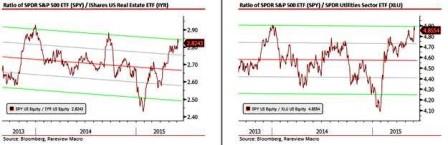
As highlighted in this morning’s edition of Sight Beyond Sight, the ratio of the iShares U.S. Real Estate ETF (IYR) and Utilities Select Sector SPDR Fund to the SPDR S&P 500 ETF Trust (SPY) is now trading at approximately two standard deviations away from its regression line since US interest rates peaked in September 2013.

rvr jun4

A short while ago in the model portfolio, we initiated a new mean reversion strategy in both of these ratios.

Specifically, we are buying $10 million notional each of IYR and XLU, and selling $20 million notional of SPY over the rest of today at VWAP.

Tomorrow, depending upon the results of the US Labor Report, we will add an additional $10 million notional each of IYR and XLU, and sell an additional $20 million notional of SPY in the morning.

Below is a thesis and trade matrix with a pre-defined game plan for gains and losses. Continue reading

Crude Oil-This Global Macro Trading Expert Says This About That

MarketsMuse Global Macro Trading dept. merges with our ETF dept. to provide the following excerpt profiling a compelling and conservative Crude Oil-centric strategy courtesy of global macro think tank Rareview Macro LLC. The following was posted to subscribers of “Sight Beyond Sight” on Wednesday, May 27. Irrespective of subsequent three day’s pricing and trade activity across crude oil marketplace, MarketsMuse editors have determined the strategy proposed by Rareview Macro’s Neil Azous remains ‘evergreen’ (for the time being).

Neil Azous, Rareview Macro

Today we got long on WTI crude oil in the model portfolio. Take it for what it’s worth, but this is the first time we have traded Crude Oil during this entire corrective phase stemming back to last summer. As per the March 18th edition of Sight Beyond Sight, when we put a long crude oil strategy on our watch list for a reduction of the severe contango in the futures curve, we are finally comfortable with the risk profile, especially considering volatility has been reduced by more than half since then. Sadly we did not deploy a position on March 18th as it coincidentally was the day the “barrel” bottomed.

The reason we chose to utilize a risk reversal approach today to get long on crude oil is because of the pronounced put skew in the term structure. For example, the structure we entered captures seven volatility points of skew on the ask side.

We like the risk-reward in this position. For example, if the November 2015 crude oil future (symbol: CLX5) were to fall $6 in the next one to two months, the strategy stands to lose ~$1.4mm. Conversely, if it were to rise by $6 in the same time frame the expected profit is ~$3.2mm, which returns a profit ratio of 2.28:1.

Sidebar: A similar strategy can be employed in the US Oil Fund (symbol: USO) by buying the 10/16/15 $21.5 calls and selling the $16 puts, but the ETF position is vulnerable to the shape of the futures curve moving further into contango. Continue reading

ETFs To Watch This Week Include ETFs Involved In Oil and The Yen

MarketsMuse blog update highlights the must watch ETFs for the first week of June. The ETFs range from health care, to oil, the Japanese Yen. This update is courtesy of the Benzinga’s author, David Fabian, and his article, “Healthcare, Yen And Oil ETFs To Watch This Week“, with an excerpt from the article below.

The summer months are often characterized by lower volume and heightened volatility, which seems to be a trend that has already established itself this year.

Several important events this week have the potential to impact the market including: personal spending, motor vehicle sales and non-farm payroll data.

Here are the key ETFs to watch for the week of June 1:

Health Care Select Sector SPDR XLV 0.25%

Healthcare stocks have continued to show tremendous strength this year and XLV has been one of the leading sector components of the S&P 500 Index. This ETF is made up of 57 large-cap stocks in the pharmaceutical, biotechnology and medical services fields. Top holdings include well-known companies such as Johnson & Johnson JNJ 1% and Pfizer Inc PFE 0.9%.

CurrencyShares Japanese Yen Trust FXY 0.1%

After appearing to stabilize through the first four months of the year, the Japanese yen currency has once again plunged markedly lower versus the U.S. dollar in May. FXY tracks the daily price movement of the yen versus the U.S. dollar and is down 3.64 percent so far this year.

United States Oil Fund LP (ETF) USO 3.83%

Crude oil prices jumped 4 percent on Friday and managed to recoup the majority of the slide this commodity experienced in May. USO tracks the daily price movement of West Texas Intermediate Light Sweet Crude Oil futures and is the most heavily traded oil ETF.

To continue reading about why oil, the yen, and health care are must watch ETF categories according Benzinga reporter, David Fabian, click here.


ETFs Now More Popular Than Mutual Funds For Investment Advisers

MarketsMuse ETF update profiles a story that is now official: exchange-traded funds have surpassed mutual funds for being the most popular investment vehicle for investment advisers. Extract below courtesy of reporting by Chuck Jaffe/MarketWatch.com

A nail gun is a handy tool, so long as you’re not shooting yourself in the foot with it.

The same can be said for exchange-traded funds.

It’s now official that ETFs — which are mutual funds built to trade like a stock — are the most popular investment vehicle for investment advisers, but it may be possible that some investors who work with pros may not recognize that they are aiming at their own bunions.

The Journal of Financial Planning and the FPA Research and Practice Institute released the “2015 Trends in Investing Survey” this week and it showed that ETFs are now the “preferred investment vehicle” among advisers, with 81% of the wealth counselors surveyed using or recommending ETFs to clients.

That makes ETFs the top tool for advisers for the first time in the history of the study. When the study began 10 years ago, the 2006 results showed that just 40% of advisers were using or recommending ETFs to their customers.

Furthermore, over half of the advisers surveyed plan to increase their use or recommendation of ETFs in the next 12 months, far outstripping the increased usage of any other investment type.

For the entire story from MarketWatch.com, please click here


New ETF Combines Dividends And Renewable Energy Using A YieldCo

MarketsMuse blog update profiles a new ETF, Global X YieldCo Index ETF (NasdaqGM: YLCO), which launched, Thursday, May 28, 2015. The ETF, YLCO, comes from a new kind of asset called YieldCos that aim to provide a steadier income to investors through assets from the renewable energy industry. YLCO tracks the Indxx Global YieldCo Index, which is home to 20 stocks that are a part of nearly 65.7% of the ETF, YLCO ‘s weight. Some of these stocks include: 

  • TerraForm Power (NasdaqGS: TERP)
  • Brookfield Renewable Energy Partners (NYSE: BEP)
  • SuneEdison (NasdaqGS: SUNE)
  • First Solar (NasdaqGS: FSLR)

This MarketsMuse blog update is courtesy of ETFTrends’ Todd Shriber and his article, “Dividends and Renewable Energy? There’s an ETF for That“, with an excerpt below. 

ETFTrends-logo

Renewable energy stocks and dividends are not often thought of as synonymous, but an emerging asset class is changing that.

YieldCos are income-generating assets from the renewable energy space that look to deliver steady income to investors. Spun off as fully developed assets from parent companies, such as solar firms and wind farm operators, yieldcos are comparable to master limited partnerships (MLPs), an asset class that has been widely embraced by income investors in recent years.

A new ETF, the Global X YieldCo Index ETF (NasdaqGM: YLCO) helps investors access the burgeoning yieldcos asset class.

“YieldCos are formed when energy companies spin off fully developed assets, such as wind and solar farms, with long term contracts and an objective of returning cash flows to shareholders. Market capitalization for the YieldCo industry currently stands at $39 billion. With 11 announced IPOs in the pipeline, it has become an increasingly popular vehicle for energy firms,” according to a statement issued by Global X.

 To continue reading about this new ETF, YLCO, and the things it could do, click here.