Tag Archives: marketsmuse

Oh My! RIAs: Forbes Advisor Playbook iConference-Sep 17-CE and CFP Credits

For RIAs who want to be smarter (and at the same time, earn CFP and CE credits, MarketsMuse points you to the Sept 17, Forbes Advisor Playbook iConference. Why? Well for one, Shark Tank shark extraordinaire Kevin O’Reilly a newbie ETF Issuer of exchanged-traded funds firm “O’Shares”  (whose first product is OUSA) will be a guest speaker, along with a list of other industry luminaries that include Schorders’ Head of US Multi-Sector Fixed Income Andy Chorlton, Tim Palmer, Head of Global Interest Rates for Nuveen, Luciano Siracusano, Chief Investment Strategist for WisdomTree.

What does the day long session include? 6 timely topics ranging from Capital Markets and Game Theory to debating Optimal Active vs. Passive Portfolio Construction. MarketsMuse knows this will be a must-attend simply because the program is being coordinated by Julie Cooling of RIAchannel and our favorite ETF journalist, Todd Shriber aka ETF Godfather will be one of the program’s moderators.

What’s In It For You? 6 CFP and 6 CIMA CE Credits!

How do you sign up? Click Here!

FinTech Dept: Banks Embrace Bitcoin’s Blockchain

It doesn’t take a “markets muse” who speaks in tech talk to know that Fintech is not only fashionable, its now mainstream. And, whilst the early “jibber jabber” surrounding Bitcoin was fodder for Wall Street naysayers, including JPM’s Jamie Dimon, “the worm has turned” according to NYT columnist Nathaniel Popper, a bitcoin expert and the author of “Digital Gold: Bitcoin and the Inside Story of the Misfits and Millionaires Trying to Reinvent Money.”

For earlier MarketsMuse coverage of the bitcoin and blockchain movement, click here

In Popper’s most recent NYT column profiling the cadre of banks, along with assortment of startups founded by banking expats, the fintech fascination is less about bitcoins as a currency, and all about the blockchain technology that powers the virtual currency.

MarketsMuse Editor Note: Though some of skeptics sitting on the MarketsMuse editorial stools suggest that these fintech applications should be targeting industries that actually embrace innovation, such as online gambling and adult entertainment, we won’t diss anyone by selling near-term straddles.

“…Nowhere, though, are more money and resources being spent on the technology than on Wall Street — the very industry that Bitcoin was created to circumvent.

“There is so much pull and interest on this right now,” said Derek White, the chief digital officer at Barclays, the British global bank, which has a team of employees working on about 20 experiments that explore how the technology underlying Bitcoin might change finance. “That comes from a recognition that, ‘Wow, we can use this to change the fundamental model of how we operate to create our future.’”

For people like Mr. White, Bitcoin isn’t just a digital token to use for online purchases. Instead, many of the top minds in finance have come to believe that the software that brought the virtual currency into existence also enables a fundamentally new way of transacting and maintaining records online — allowing people and banks to directly exchange money and assets like stocks and bonds without having to rely on a long chain of expensive middlemen…”

A few banks have gone public with their work, but most of the activity has been happening behind the scenes. At one private meeting, held in April at one of the Manhattan offices of Bank of America, executives from more than a dozen large banks gathered to confidentially discuss how the technology underlying Bitcoin could be used to change foreign currency trading, the largest financial market in the world, according to people who attended the meeting.

Central banks like the Federal Reserve and the Bank of England have their own teams looking at the technology.

“A year ago, it was more of an idea,” said Max Neukirchen, the head of corporate strategy at JPMorgan Chase. “Now, it is a real opportunity. You test it and realize that this can play a big role in our thinking about how our own infrastructure will evolve.”

Who are the players to watch? Aside from the secretive projects inside of each of the 6-pack shops (including JPM!), major exchanges including NASDAQ and NYSE owner ICE are actively throwing resources at blockchain technology applications. On the startup scene, Dave Rutter, a former inter-dealer broker who was a head capo at Prebon Yamane, and then CEO OF ICAP before starting electronic broker LiqudityEdge is now wearing two hats via his role at blockchain wannabe R3CEV LLC. Not to be outsmarted is Mark Smith’s “Smart Securities” product, created by his startup Symbiont. Smith is the former co-founder and COO of Lava Trading and a certified tech wonk with a keen FX markets expertise.  His company, with help from fintech merchant bank SenaHill Partners has so far outfoxed R3CEV by having already set the stage to facilitate the first corporate bond issuance using the blockchain technology.

For Nathaniel Popper’s latest commentary “Bitcoin Technology Piques Interest on Wall St”., please click here

Rule 48, ETF Dislocation: BATS CEO Says “No Humans Needed”

When ETFs were first launched in 1993, the ‘framers’ might not have fully appreciated what would happen to the respective ETF cash index in the event of a lopsided market opening when the underlying constituents had not yet opened for trading, despite the easy recall of October 1987..

Since that time, market structure experts and the cast of exchange characters regulated by the SEC have introduced a litany of steps, including NYSE’s Rule 48 that are designed to serve as circuit breakers to bring calm to the chaos caused by out-sized volatility, particularly during market openings. According to observations in the wake of the most recent market turmoil, when ETF market-makers stepped back and provided wide-as-a-truck pricing because constituent issues had yet to open, the CEO of BATS Global Markets, the electronic trading platform that has grown from the size of mouse to being one of the bid kids on the block, sent a signal to the media that led many, including MarketsMuse editors, to infer that he believes that humans are no longer relevant in the new age of Wall Street, computer horsepower and smart algorithms.

As noted by the WSJ in its Sep 1 story by Bradley Hope , “…in a strongly worded rebuke to its rival and NYSE operator Intercontinental Exchange on Tuesday, BATS Chief Executive Chris Concannon said that NYSE Group’s process for opening trading on stocks listed at the exchange was “broken” and that major changes needed to be made to protect investors from future problems. “No one on the planet operates that way, and no one should operate that way,” he said in an interview, adding that he sees “very limited value” in the use of humans on the trading floor

Some traditional market experts have since quietly suggested that Concannon “could have bets in his belfry if he believes that computers should be taken out of the equation.”

NYSE officials and floor brokers have argued for years that they serve a crucial role providing slower trading within today’s high-speed, electronic markets.

“The debate is about whether we need a slower market structure or a faster market structure on days with large systemic volatility,” said David Weisberger, managing director at market-analytics firm RegOne Solutions. The slower version is driven largely by people, whereas the faster one is controlled by computers and trading algorithms, he added.

The NYSE spokeswoman defended the exchange’s approach by contrasting it with a notable failure that BATS experienced itself with its own initial public offering.

Here’s the two points of Rule 48 and what the debate is based on.

  • IN A NORMAL MARKET: Market makers indicate where a stock might open. That helps investors modify buy and sell orders.
  • IN A VOLATILE MARKET: Market makers don’t have to indicate where a stock might open. That should make it easier for stocks to open quickly. But investors have less information about the market prices for securities.

Ted Weisberg, a longtime floor trader and founder of floor brokerage Seaport Securities Corp., said invoking Rule 48 can speed up the opening of stocks but leads to less transparency.

“When you invoke Rule 48, you’ve opted for speed over price discovery and speed over transparency,” he said. “‘What’s in the public’s best interest is transparency and time to react.”

An NYSE spokeswoman said: “Rule 48 allows us to expedite the opening of stocks on volatile days while maintaining the hallmark transparency that we are known for.”

BATS is accustomed to Donald Trump-style brashness  In prior MarketsMuse coverage ,they are strong advocates of “pay-to-play” kickbacks that provide rebates in exchange for orders sent to their electronic venue as opposed to sending to competing electronic trading venues. Here’s an excerpt from that story: Continue reading

Global Macro Rareview: ETF Investors and The Ivy Portfolio

If the second shoe is actually falling as US (and all other) equities markets appear to indicate this morning, MarketsMuse ETF and Global Macro editors were stimulated by having Sight Beyond Sight with this morning’s coffee, courtesy of Rareview Macro’s Neil Azous. Of particular interest, Azous points to Mebane Faber’s The Ivy Portfolio for those who have defaulted to using exchange-traded funds and to the reference to Occam’s Razor, a principle that global macro enthusiasts will appreciate.

Without further ado, please find an extract from this morning’s edition of Sight Beyond Sight…

Corporate Buybacks Not Strong Enough to Save Stocks Today…Retest of the Lows Now Underway

  • Negative Statistical Analogs
  • No September First of the Month Inflows
  • China Quantitative Tightening (QT)
  • Trends Switch to Medium- from Short-Term
  • Correlation Breakdown
Neil Azous, Rareview Macro

The key takeaways to start September are invisible to the naked eye; a little sight beyond sight is required this morning in order to see them clearly.

Firstly, we are not sure who the source was, but the following S&P 500 analog was sent to us:

In the 11 times the S&P 500 fell by more than 5% in August it declined in 80% of the subsequent Septembers; the average decline in September in those years was 4%.Now, there are many statistics with similar odds of success being circulated out there, but in aggregate these one-liners miss the bigger picture, in our opinion.

The message is that the higher volatility witnessed during August has carried over into September. It took eight hours of the overnight session for S&P futures (ESU5) to confirm 65% of the above analog, as the index was -2.6% at one point.

Secondly, the first of the month inflows into risk assets that professionals are accustomed to relying on to support their long equity positions has gone missing this year. Inflows into equities are generally expected to follow the simultaneous release of PMI manufacturing data, especially when the data historically points to a stronger global growth profile. However, the data released this morning was uniformly weak, and serves as a reminder of the regional synchronicity – that is, Japan’s consumption-led recovery is faltering, the US has a second half of the year inventory overhang to work through, Europe’s inflation profile is reverting back to pre-“QECB” profile, and China remains an unknown.

Thirdly, given the overall weakness in risk assets the sell-off in the German Bund (RXU5) over the last 24-hours is confounding professionals. Occam’s Razor, a principle that states that among competing hypotheses that predict equally well, the one with the fewest assumptions should be selected, suggests that the Chinese central bank is once again selling dollars and foreign fixed income reserves to buy yuan. As a reminder, FX intervention means foreign reserves have to shrink. The mechanics are as follows: sell foreign sovereign bonds > receive US dollars (USD), euro (EUR), yen (JPY) > use USD/EUR/JPY proceeds to buy CNY = no impact to private economy.

The Chinese Yuan, both the onshore (USD/CNY) and offshore (USD/CNH) versions, is trading at its strongest level since the devaluation. The key difference today however is that the central bank is not defending yuan weakness. Instead, in the spirit of managing volatility, it appears it is proactively reminding speculators who their daddy is and doing a good job of crushing their souls at the same time.

Next.. Continue reading

SunGard ETF Pricing Glitch Update: BNY Has $220bil Headache

As reported earlier this week by MarketsMuse, a “computer glitch” suffered by market data vendor Sungard Systems has left custodian BNY Mellon still scrambling to price Net Asset Value (NAV) for nearly 10% of exchange-traded funds held by customers. Late Wednesday, BNY said 20 mutual fund companies and 26 ETF providers have experienced “some pricing problems.” According to sources, the snafu has impacted $220bil worth of assets.

According to Bloomberg news, “A technology breakdown at Bank of New York Mellon Corp., leaving it unable to price more than 10 percent of U.S. exchange-traded funds and some mutual funds, may be causing investors to overpay for them.

BNY Mellon said Thursday in a statement that it’s working “round-the-clock” to fix a technology issue at vendor SunGard Data Systems Inc. The snafu has prevented the bank from issuing net asset values, the equivalent of closing prices, for the funds. The bank said 20 mutual fund companies and 26 ETF providers have experienced some pricing problems.

The bank said customers have been able to continue trading the affected funds. But in the absence of accurate prices, some investors may have paid more than they should when purchasing them, said Ben Johnson, director of global ETF research at Morningstar Inc.

Johnson said that figuring out how to compensate investors hurt by the system failure will be a headache. He said mutual fund investors are likely to suffer more damage, because net asset values play a more critical role for funds than they do for ETFs.

U.S. Securities and Exchange Commission rules do not specifically address this matter, said an SEC official who asked not to be named. The bank’s liability may depend on the wording of its contractual agreements with the funds rather than securities law, the official said.

Kevin Heine, an BNY Mellon spokesman, declined to comment on the matter.

SunGard Apology

SunGard, a financial software company with annual revenue of $2.8 billion, said in a statement Thursday that the incident was not caused by any external or unauthorized system access, and wasn’t related to the market turmoil this week. The issue was caused by an operating system change performed by SunGard on Saturday, Aug. 22.

“We at SunGard apologize to BNY Mellon for the adverse impact this unfortunate incident has had on its operations and clients,” SunGard Chief Executive Officer Russ Fradin said…”

For the full story from Bloomberg, please click here

ETF Pricing Glitch Rattles BNY; SunGard Software Snafu

When it rains it pours. While many ETF investors have been sucker-punched while trying to execute orders during the past several highly volatile days, MarketsMuse finds that a second shoe dropped Monday on the heads of thousands of BNY Mellon customers thanks to a software snafu attributed to market data vendor SunGard systems. The “computer glitch” has impacted the Net Asset Value (NAV) pricing for nearly 800 exchange-traded funds and mutual funds administered by BNY, the world’s largest custodian.

According to the Wall Street Journal, BNY Mellon raised the alarm with regulators and held emergency calls with customers to try and resolve the problem.The system, known as InvestOne and run by financial software provider SunGard, resumed with limited capacity on Tuesday but was still not fully operational on Wednesday, leaving BNY Mellon with a backlog of funds to price.

sungard glitch1Morningstar, Inc., the fund research firm said that 796 funds were missing their net asset values on Wednesday, including ETFs operated by Goldman Sachs, Guggenheim Partners and several dozen mutual funds sold by Federated Investors. Invesco PowerShares Capital Management had 11 ETFs affected by the glitch, a spokeswoman said.

BNY Mellon said it was able to construct Monday net asset values (NAVs) for all affected funds. But there remains a backlog of Tuesday NAVs that still need to be generated.

The problems with calculating the net asset value of ETFs could raise trading costs for investors, said Todd Rosenbluth, director of ETF and mutual-fund research at S&P Capital IQ.

Several traders said they were forced to calculate their own net asset value for ETFs and that they widened the spreads, or the difference, between listed buying and selling prices to accommodate for the higher risk of trading.

“We measure our edge in terms of subpennies,” one trader said. “We can’t afford to be off by a penny.”

Early in the week, BNY Mellon notified regulators and U.S. stock exchanges about the issue. The Securities and Exchange Commission is monitoring the situation, an SEC official said.

“No one here can understand why it’s not up and running yet,” said one executive at a firm that was affected.

For the full coverage by the WSJ, please click here


Market Mayhem: A Rare View From Global Macro Guru

One needs to have ‘been there and seen that’ for at least twenty years in order to have been “loaded for bear” in advance of this morning’s equities market rout. At least one of the folks who MarketsMuse has profiled during the past many months meets that profile; and those who have a true global macro perspective such as Rareview Macro’s Neil Azous have pointed to the credit spread widening during the past number of months as a prime harbinger of things to come. And so they have…

Neil Azous, Rareview Macro

Last night, Neil Azous published one of his finer commentaries in advance of this morning’s global equities market rout and incorporated a great phrase:

“Man looks in the abyss, there’s nothing staring back at him. At that moment, man finds his character. And that is what keeps him out of the abyss.” – Lou Mannheim, Wall Street, 1987


The highlights of last night’s edition of “Sight Beyond Sight” are below…

  • Big Picture View
  • S&P 500 View
  • Asset allocation Requires Swimming Against the Tide – Low-to-Negative Downside Capture
  • Long German versus Short US Equities (Currency Hedge)
  • US Fixed Income – Short 2016 Eurodollars
  • Long European & Japanese Equities (FX hedged), US Biotech and US 10-Yr Treasuries
  • Long US Energy Sector
  • Volatility – Sell Apple Inc.; Not the S&P 500 or VIX
  • Harvesting S&P 500 Index Option Skew
  • Long Agricultural Call Options
  • Long US Housing (Hedged)
  • Technical Mean Reversion – Short EUR/BRL
  • Long Euro Stoxx 50 Index Dividend Futures (symbol: DEDA Index)

To read the full edition of the Sight Beyond Sight special Sunday (Aug 23 2015) commentary, please click here*

*Subscription is required; a free, 10-day trial is available

Neil Azous is the founder and managing member of Rareview Macro, an advisory firm to some of the world’s most influential investors and the publisher of the daily newsletter Sight Beyond Sight.

Into Africa: Exchanges To Cross-List Local ETFs

When investors think about ETFs, most are focused on the nearly 2000 products that trade within US markets and leading countries in the EU; few realize that Africa is no longer just a ‘Frontier Market’, and some go as far to argue that Africa (once again?) represents a burgeoning investment marketplace.

Aside from various market prognosticators who are promoting the “Into Africa” message, local exchanges across the region are taking steps to convey that very same message. According to recent reports, talks are under way between market participants in South Africa, Nigeria and Kenya to launch the cross listing of exchange traded funds (ETFs), a move that is intended to lead to improved liquidity on Africa’s exchanges.

While many know The Market Vectors Africa Index ETF (NYSEARCA:AFK) for being perhaps the most efficient way to express exposure to the entire region, ETF issuers are working to cross list new and existing ETFs on other exchanges, while the exchanges themselves are putting in place the right frameworks to enable this.

The concept of cross listing an ETF is the same as cross listing a share, or listing it on more than one exchange. It provides domestic investors with access to opportunities from another market, in the convenient and cost effective form of an ETF. By cross listing ETFs on African exchanges, investors will be given access to liquid company shares tracked by indices such as the FTSE/JSE Top 40, the FTSE/NSE Kenya 15 Index, and the MSCI/Nigeria.

African-Stock-Market-Performance-at-Mid-Year-2015-11Africa’s Fastest growing asset class: Exchange-Traded Funds

“ETFs are one of the fastest growing asset-class categories in the world. By collaborating with Africa’s largest stock exchanges, we hope to spearhead this trend in Africa,” explains Donna Oosthuyse, the director for capital markets at the JSE.

Added Oosthuyse, “The cross listing of ETFs will fulfil two main functions: investors will have exposure to a diverse range of top-performing South Africa, Nigerian and Kenyan companies in a convenient and cost-effective way; and the cross-listings of ETFs will improve the liquidity of Africa’s largest stock exchanges.” Oosthuyse says that the advantages for companies included in the ETF indices, and for the exchanges from whence they come, are that ETFs need to be “fully covered”. “This means that the asset manager that is managing the ETF portfolio has to buy and sell the underlying shares on the home exchange, depending on the activity of buying and selling of the ETF.”

Home market liquidity

If an ETF from Kenya or Nigeria, for instance, is listed on the JSE, she adds, then the asset manager in Kenya or Nigeria has to buy and sell the constituent shares on the home market, as units in the ETF are bought and sold. This drives liquidity in the home market.

“In addition to this, it provides extra visibility on the shares on that exchange to new investors who in all likelihood don’t yet trade on that market.” Haruna Jalo-Waziri, the executive director of business development at the Nigerian Stock Exchange, says: “This collaboration underscores our commitment to providing investors with a wide range of investment products to help them realise their financial goals. ETFs are becoming attractive to many investors offering them portfolio diversification and reduced cost of investing.

Building African Financial Markets Seminar

Meanwhile, as part of an on-going effort to deepen and promote liquidity, choice of products and investor interest across African markets, the JSE and the African Securities Exchanges Association (ASEA), supported by the World Bank Group, will be hosting the third Building African Financial Markets Seminar from 16 to 18 September. The conference will gather key representatives from stock exchanges, regulatory bodies, stockbroking firms and other market participants from several African countries. Ideas on how to grow Africa’s capital markets will be discussed.
MarketsMuse.com editors invite you to read more: http://southafrica.info/africa/etf-africa-170815.htm#.VdNRUZcnhcQ#ixzz3jBJeRlbE

Trading Ahead: Dark Pool Operator ITG Gives Itself Best Ex and Gets $20mil Fine

According to the BrokerDealer.com blog, MarketsMuse reports that “dark pool” operator ITG and its agency-only, best-ex, ‘conflict free’ brokerdealer affiliate AlterNet Securities appear to have been providing themselves with best-ex by capturing order information from ITG institutional customers and for that, they will pay  a record SEC fine of $20.3 million to settle charges that they operated a secret trading desk, the U.S. Securities and Exchange commission announced this week.

As described the SEC — and, unusually, admitted to by ITG ( ITG, -4.29% ) — there were two main charges — that the company operated a proprietary trading desk when it claimed to be “agency only,” and that it then used the confidential trading information of its dark-pool subscribers without disclosing that.

The regulator “found that despite telling the public that it was an “agency-only” broker whose interests don’t conflict with its customers, ITG operated an undisclosed proprietary trading desk known as “Project Omega” for more than a year.”

On Monday, ITG CEO Bob Grasser stepped down to be replaced by E*trade veteran Jarrett Lilien in the wake of the scandal and news of the SEC’s proposed fine. ITG General Counsel Mats Goebels also resigned, according to news reports.

An SEC press statement added, “[while] ITG claimed to protect the confidentiality of its dark pool subscribers’ trading information, during an eight-month period Project Omega accessed live feeds of order and execution information of its subscribers and used it to implement high-frequency algorithmic trading strategies (aka “HFT”), including one in which it traded against subscribers in ITG’s dark pool called POSIT.”

BrokerDealer.com provides a global database of brokerdealers operating in more than three dozen countries throughout the free world. – See more at: http://brokerdealer.com/blog/#sthash.6VqFIQkG.dpuf

Unlike previous SEC settlements where the accused pays a fine and does not admit any guilt, ITG admitted wrongdoing. Further, it will “pay disgorgement of $2,081,034 (the total proprietary revenues generated by Project Omega) plus prejudgment interest of $256,532 and a penalty of $18 million that is the SEC’s largest to date against an alternative trading system,” according to the SEC. 

For the full story from BrokerDealer.com, please click here


Up at BATS: Another Edge; EDGX Options Exchange Approved

MarketsMuse Strike Price section spots news that BATS Global has received approval from the Securities and Exchange Commission to open its second options trading venue, EDGX Options. Launch of the EDGX Options system is tentatively set for Monday, November 2, BATS said.

The actual SEC Approval Order from the SEC can be found here.

As reported by Traders Magazine, EDGX Options will be based on a customer priority/pro rata allocation model and is designed to complement its BZX Options market, the exchange operator’s first U.S. options market which had a 10.8% market share in July, and one that is a “pure” price-time priority market. The launch of EDGX Options will enable BATS to compete for a new segment of order flow that does not trade on the price-time markets that BATS currently operates.

“We are pleased to receive approval from the SEC to launch EDGX Options and we are looking forward to making our mark in a new segment of the options market,” said Bryan Harkins, executive vice president and head of U.S. Markets at BATS. “Two-thirds of U.S. options market volume is executed on exchanges with a pro rata model and we believe we can help make markets better for participants in this segment of the market through our innovative technology, operating efficiency, market-leading pricing, and first-class customer service.”

Attention Wall Street BlockHeads: Get Your Bitcoins Here

MarketsMuse fintech update is a “bid on” to prior Wall Street bitcoin initiative coverage, and following is courtesy of excerpt from 4 Aug story by Bloomberg LP reporter Andrew Leising, ” Wall Street, Meet Block 368396, the Future of Finance.”

Justin Brownhill, SenaHill

When Justin Brownhill wants to check up on one of his latest investments through fintech merchant bank SenaHill Partners LP, he only needs to check the ledger unpinning bitcoin. The address: block 368396.

That’s the new digital home for the equity stake his firm made in Symbiont, a startup using bitcoin’s underlying blockchain software to make it quicker and easier to prove ownership of assets or transfer them between buyers and sellers.

Putting its money where its mouth is, Symbiont on Tuesday morning digitized and published several of its equity investments to the blockchain, which drives the bitcoin digital currency. That means the stakes will forever be part of that public record, allowing dividend payments or stock-option conversions to happen automatically.

“I woke up this morning and thought, ‘This is a historic moment,’” Brownhill, a managing partner at New York-based SenaHill, said in an interview after the Symbiont presentation on Tuesday. The merchant bank has investments in over a dozen other private companies. “Our job now is to go and espouse the benefits to all our portfolio companies,” he said.

Wall Street is becoming enamored with the potentially transformational way blockchain could overhaul how derivatives, bonds, loans and other asset classes work, dramatically simplifying the process of tracking ownership and accelerating the transfer of assets from one person to another.

Smart Securities

Symbiont’s innovation is creating what it calls smart securities. The company is now practicing what it preaches: its founders’ stakes as well as shares and options granted to employees have been converted into encrypted code that lives in the bitcoin blockchain — the same ledger where any purchases and sales of the digital currency are recorded. Symbiont customers can do likewise to track changes in ownership interests.

“Today is the day crypto joins Wall Street,” Symbiont Chief Executive Officer Mark Smith said to the room full of investors, bankers and reporters in New York. Representatives of JPMorgan Chase & Co., Morgan Stanley and other financial institutions were among the audience members.

Symbiont’s not alone in trying to bring the blockchain to Wall Street. Other firms investigating finance-related uses of blockchain include Digital Asset Holdings LLC, headed by former JPMorgan Chase & Co. banker Blythe Masters; Nasdaq OMX Group Inc.; Ripple Labs; and the New York Stock Exchange.

In June, Symbiont raised $1.25 million from a group of investors including former NYSE chief Duncan Niederauer; former Citadel LLC executive Matt Andresen; two co-founders of high-frequency trading firm Getco LLC, Dan Tierney and Stephen Schuler; and SenaHill.

For the full story from Bloomberg LP, please click here

News Alert: SEC Set To Hit Pimco With Wells Notice in Probe of Bond ETF

Bond giant Pacific Investment Management Co. aka Pimco said Monday that it received a Wells Notice from the SEC and the firm could be sued by the country’s top securities regulator over how it valued assets in ETF $BOND, one of its most popular exchange-traded bond funds aimed at small investors.

MarketsMuse Flash News courtesy of WSJ; photo image courtesy of Bloomberg LP.

The Pimco Total Return ETF, previously managed by star investor Bill Gross, has been under investigation by the Securities and Exchange Commission for at least a year for artificially boosting returns, The Wall Street Journal has reported.

Pimco disclosed Monday that it received a so-called Wells notice from the SEC, an indication that the agency intends to file a civil enforcement action against the firm related to its investigation. The notice isn’t a formal allegation of wrongdoing and it doesn’t mean the agency has found that any laws were violated.

The original story from WSJ is available via this link

Global Macro Think Tank Rate Hike Hedge: A Rareview Special

Within the context of continuous guessing as to the outlook for a rate hike, and how to hedge fixed income portfolios accordingly, getting a strong fix on fixed income strategies has proven to be a challenge for a vast majority of professional investors during the past 24-26 months, many of whom have replaced high-priced wall hangings with dart boards.  Many other managers prefer to simply hum “Lower for Longer” to themselves. For global macro-focused fund managers, MarketsMuse spotlights a refreshing update from Rareview Macro LLC, the global macro think tank and publisher of professional newsletter “Sight Beyond Sight.”  Below please find opening excerpt from today’s edition

Neil Azous, Rareview Macro

We are pleased to present our new portfolio construction, including four new trade ideas and a tail risk hedge that make up our core fixed income strategy. As is customary, each one includes our standard trade matrix with a pre-defined game plan for managing gains and losses.

For those that regularly traffic in fixed income, we look forward to any feedback you may have and a spirited debate on our ideas. We are confident they are sufficiently robust to survive some criticism.  For those not in fixed income, please feel free to share this internally with your colleagues who are.

  • TRADE 1 – Gradual/Variable pace of rate hikes
  • TRADE 2 – Leverage on Gradual/Variable pace of rate hikes
  • TRADE 3 – Targeted field bet on no rate hikes in 2015, recession book overlay
  • TRADE 4 – “Uncertainty” Risk Premium
  • TRADE 5 – Choke Yourself Tail Hedge

Highlights:

  • Thematic view, not tied to day-to-day movements in the long bond
  • Multiple sources of return attribution
  • High return on capital: Low option premium outlay, high leverage
  • High risk/reward: Lose 1.5% (realistic) to 3% (absolute) of the NAV to make 6% to 8%
  • Both quantitative and qualitative risks clearly expressed

Above is the teaser, those interested in drilling down into the above, today’s edition of Sight Beyond Sight is available by clicking this link.

Agency-Only Executing Broker: What Does Best Ex Mean?

MarketsMuse dip and dash department frequently prefers spotlighting altruists and do-gooders, including Agency-only execution firms in the brokerdealer sphere who, unlike “principal trading desks”, do not take the contra side to institutional customer orders as a means of making a profit; agency-only firms merely execute those client orders via the assortment of major exchanges and dark pools that traffic in equities and equity options. Today’s spotlight is on Dash Financial; the only position they purportedly take is a business model position by promoting the fact they act as a conflict-free agent only representing the best interest of their institutional brokerage clients in consideration for an agreed-upon commission.

The phrase “Best Execution” is therefore popular jargon among agency-only firms and implies that customers are receiving ‘the best” execution. What that means is a function of who you ask, particularly when considering the brokerdealer community has proven uniquely adept at capturing hidden revenue via rebate schemes in consideration for orders routed to those respective venues for execution. These schemes are aggressively promoted by the nearly two dozen major exchange and dark pools that facilitate trading in equities and equity options.

Courtesy of our friends at FierceFinance, today’s altruist of the week award goes to equity and options market agency brokerage Dash Financial, who asserts that being a broker in today’s fast-paced market is about being a technology expert and a consultant on clients’ execution objectives.

Below is the extract from FierceFinance’s interview with Dash Financial’s CMO:

David Karat, Dash Financial

“Everything is a tradeoff,” said David Karat, chief marketing officer for Dash Financial. “Every action you take to minimize fees, you risk losing liquidity, and for every technique to maximize liquidity it will cost you more money because it will be less relevant which venues you go to get that liquidity. It’s that balance we sit on top of and consult with our clients on.”

To that end, Dash Financial aims to help clients achieve what it calls on best net execution – execution that incorporates exchanges fees and all other associated costs.

“If there is liquidity in multiple places we are going to capture that liquidity based on the cheapest economics for the client,” Karat said. But Dash Financial has also designed its tracing architecture to couple its best execution algorithms with a focus on in-depth transparency, Karat said.

“We actually want you to see all the child orders, the millisecond time stamp of which destinations we are going to and what happened,” Karat said.

Looking at an example of a client order to sell 1000 Apple May 106 puts at seven cents, Karat notes that the system not only shows that the parent order was filled, but allows clients to click through to see all the child orders associated with that parent order.

In the Apple example, there were actually 828 contracts available to satisfy the order, divided between two different venues. Dash Financial’s platform is calibrated to account for slight differences in the amount of time it takes for orders to reach different venues, and that calibration readjusts during the day as timing slows down or speeds up. After capturing all 828 orders, the millisecond that the system realized a balance remained, it reversed and posted the balance of the order to Arca, because Arca has the best rebates. The order on Arca was hit immediately.

The Dash Financial interface not only allows clients to see the child orders, but through a tool called Order Trace, clients can view everything including FIX messages sent down to the exchange for a complete audit trail for compliance purposes. In addition, a tool called a Smart Order Router Analyzer allows clients to view what Dash saw on screens at the time or the order.

Dash Financial sees its role as using its tools for visibility into execution to work with clients fine tune trade executions to fit the nuances of their strategy.

“What we do is look at that behavior when they are executing and we might say, in this type of scenario, it might make sense to be a little more aggressive, or a little less aggressive and this is what we suggest,” Karat said. “We will go back and redesign how the algorithm behaves in a certain situation or we will give them another algorithm for a specific nuance, and compare it against existing behavior so we can quantify whether it is worth changing again or keeping as it is.”


Actively-Managed ETF Smackdown: Eaton Vance vs. Precidian

As reported previously by MarketsMuse, actively-managed ETFs, aka AMETFs (or as Eaton Vance has dubbed their product: “NextShares ETMFs”) are the next holy grail for Issuers of exchange-traded funds simply because these new-fangled products offer a refreshing new batch of flavors to a product category that has nearly 2000 issues whose structures are pretty much the same and all are intended to compete with traditional mutual funds. Eaton Vance is a pioneer in actively-managed exchange-traded funds, and Precidian Investments is biting on their heels so far with their proposal for “ActiveShares”. The difference between the ‘actively-managed’ types vs. the plain vanilla ETFs is total lack of transparency; investors in actively-managed ETFs do not know what the underlying components are, so the value proposition is presumably based on the ETF managers’ capabilities.

For some, actively-managed ETFs are the perfect product for hedge fund operators to promote, given that hedge fund investor appeal for investing in hedge funds is the secret sauce each of them purportedly uses to make profits for investors, or per industry jargon, “capture Alpha.”

For ETF market-maker veterans, the notion of not knowing what the underlying components are is counter-intuitive. Unlike a traditional, single stock specialist who makes a two-sided market in IBM, and is willing to either buy or sell based on their ability to gauge which direction the stock is headed next, ETF market-makers don’t take that kind of risk, they make money by providing a two-sided aka bid-offer market in any particular ETF  based solely on their ability to arbitrage the underlying components vs. the cash price of the ETF. In simple speak, an ETF market-maker is only interested in offering 50,000 or more shares of the ETF if they can simultaneously purchase the underlying constituents of that ETF at an aggregated price that is less than the current offering price of the ‘parent’ ETF.  They will only make a bid for a block size trade if they think they can simultaneously sell-short the underlying constituents such that the aggregate ‘sale price’ is greater than the price they pay for the cash ETF product.

Irrespective of whether actively-managed ETFs can prove to be liquid trading vehicles, which is arguably a criteria for most investors, NextShares non-transparent product has been approved by the SEC, while its competitor, Precidian Investments continues to face hurdles with the regulators. Perhaps this is a who-you-know issue. As noted by WSJ’s coverage by Daisy Maxey:

Regulators denied a second request from Precidian Investments for approval to launch actively managed exchange-traded funds that wouldn’t have to disclose their holdings daily, as ETFs now do. The latest SEC denial of Precidian’s ETF plan “ActiveShares”became public Monday when competitor Eaton Vance posted it on its website. In October, the SEC denied Precidian’s filing for a nontransparent active ETF that would trade on an exchange. Precidian refiled with the regulator in December after making changes, seeking exemptive relief to launch its funds, which it called ActiveShares.

But in a denial letter dated April 17 that just become widely available, the SEC notes that it had previously denied a “substantially similar” proposal from Precidian.

Daniel McCabe, chief executive at Precidian, said the company is in a “fruitful” and ongoing dialogue with regulators, and plans to refile to launch the funds.

The latest SEC denial of Precidian’s ETF plan became public Monday when competitor Eaton Vance Corp. posted it on its website. Eaton Vance, which has received SEC approval to launch a related product called exchange-traded managed funds, said it obtained the SEC communication to Precidian through a Freedom of Information Act request. Precidian’s product would have been a competitor to the ETMFs planned by Eaton Vance.


GlobalMacro Rare View: Fixed Income Market Flashing Recession Alert?

MarketsMuse Global Macro and Fixed Income desks converge to share extract from 23 July edition of Rareview Macro commentary via its newsletter “Sight Beyond Sight”. For those not following the corporate bond market, most experts will tell you the equities markets follow the bond market–which in turn is a historical indicator when it comes to economic expansion, contraction, and recession. Below is courtesy of Rareview’s founder/managing member Neil Azous .

In the past few days, US investment grade (IG) credit spreads have reached new three year wides. Historically, the absolute level of these spreads is consistent with periods of economic and financial market stress. Additionally, the daily volatility of these spreads has increased dramatically in recent weeks.

Below is a chart of the Moody’s Baa Corporate Bond yield spread over the US 30-year Treasury yield.
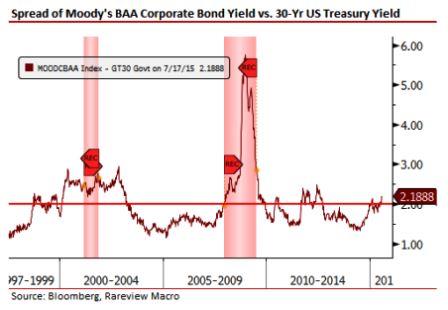
What is the significance of this observation?

Investment grade corporate bonds are one of the least risky investments within the capital structure, and less sensitive to changes in default risk due to economic weakness. Moreover, the credit market is arguably, next to the slope of the yield curve, the greatest predictor of future economic stress.

The most widely cited explanation for the recent widening in spreads is that it is due to the amount of new investment grade credit issuance. Indeed, that is one factor as new issuance (+SSA) set a record pace yesterday after having surpassed $1 trillion, a level not reached last year until mid-September.

However, the recent widening of the spreads is not just down to the recent surge in corporate issuance. Issuance is simply not a large enough driving force to cause this level of “stress”. The reasons for this widening are two-fold.

Firstly, the aggregate level of issuance, to a degree, is beginning to finally catch up with the market after years of sensational appetite. Corporations, in aggregate, are raising their leverage levels by issuing the new debt and not using the proceeds to grow their revenues or cash flows to compensate. Put another way, the market is beginning to segregate between issuance related to refinancing a company’s “credit stack” as part of its normal annualized funding requirements and pure capital redeployment for the benefit investors.

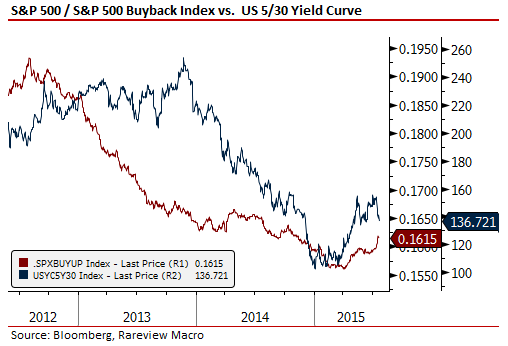
By the way, as we have pointed out in these pages for a while now, not only is the IG spread widening, signaling the distinction noted above, but the equity markets are now doing so as well. Again, see the below chart of the ratio of the S&P 500 to the S&P 500 BUYUP index overlaid with the US Treasury 5-30yr yield curve. Stock buy-backs are simply underperforming in 2015 after multiple years of outperformance as the yield curve steepens in anticipation that interest rate hikes will slow the capital redeployment process down. As a reminder, it is much easier to slow a buy-back than reduce a dividend as the former has a time-band and discretion to implement and the latter generally is a board-level decision.
Secondly, we are aware that discussions around the lack of liquidity in the credit markets are a near daily occurrence these days. The only observation of note is that there is now a new term associated with the market construct – that is, “liquidity cost basis”. In simple terms, due to the lack of market depth and the continued sensational appetite to issue bonds, there is now a higher premium being applied in the market to finding liquidity if you want to own a bond. All we are saying is that the investor concerns over liquidity are not only being priced into the market but those worries have been crystalized with a fancy Wall Street name.


The end result is that investors are demanding a higher premium for the new issues they are taking down, largely due to deteriorating fundamentals in the actual credit.


Now, the second most widely cited explanation for the spread widening is that it is due to the energy sector. If you decompose the spreads it is easier to argue that a notable portion of the weakness is due to the deterioration in the energy sector, whose credit spreads are highly correlated with the lower price of crude oil. However, energy makes up a much smaller portion of the investment grade market (~12%)  than it does for the high yield (i.e. ~18%+), which indicates that the breadth of weakness stretches across many other sectors of the investment grade market and is not due to one single risk factor, such as crude oil.

Lastly, we would note that the absolute levels of these spreads referenced on the chart above are also consistent with weakness after the US quantitative easing program was completed and in anticipation of an interest rate hike. We are not sure how much of the spread widening is a result of this less easy monetary policy but the fact is that both QE and the zero interest rate policy forced investors to perpetually search for yield and investment grade credit was a major source of that appetite. To what degree that happened is difficult to handicap but some of those inflows have to reverse given how asymmetric the outcome would be if the Federal Reserve actually embarked on a rate hiking cycle consistent with past cycles, as opposed to a gradual pace of hikes.

Taking a step back, if you look at both the US yield curve and the credit markets, what you find is that both are saying roughly the same thing – that is, there is currently a recession risk embedded in the market, and that there is the potential for the end of this credit and/or economic cycle to be on the horizon.

Take what we have just sketched out any way you want. We are not making a bearish call on risk assets or attempting to sell blood. All we are doing is saying that credit markets, the yield curve and corporate share repurchase trends are signaling some concern sometime over the next 6-9 months. Given that we have not had a recession in 6-7 years, and historically we have had one every four years on average in the modern era, it is not at all unreasonable to start to watch these signals a lot more closely from now on for something more acute.

Above segment from investment newsletter Sight Beyond Sight is re-published with permission from global macro think tank Rareview Macro LLC. Subscription to the daily commentary and trade strategy profiles is available via the firm’s website


FinTech Fire in the Hole- Bond Trading Platform Bondcube Blows Up

Introducing electronic trading to the corporate bond culture is not easy. Fintech initiatives have been trying to crack this egg for 20 years, each promoting the theory that enhanced transparency via electronic trading leads to enhanced corporate bond market liquidity, and ultimately, a robust marketplace for institutional traders to traffic corporate debt and/or via the classic inter-dealer broker business model.

So far, MarketAxxes, which launched in the late ’90s and is best known for bringing small size trades together (under $2mil notional) is one of few that have been able to survive. That said, electronifying the corporate bond market has witnessed several start-up cycles during the past two decades; this current decade counts more than one dozen initiatives; well, that count is “less one” when considering the following news from Finextra.com:

Bondcube, an electronic trading platform for corporate debt, has filed for liquidation just three months after going live.

The startup, backed by Europe’s largest exchange Deutsche Börse, was one of more than 30 new platforms that have emerged in the corporate bond market as a result of new regulations.

Under current capital rules, banks are restricted in the amount of corporate bonds they can hold on their balance sheet, despite the fact that the amount of outstanding corporate debt has risen by nearly 50% to $48 trillion since the financial crisis.

Bondcube and its fellow startups have tried to fill this gap in the bond market by providing buyers and sellers a centralised venue to trade electronically, akin to the various crossing platforms that have emerged in the equities market. The company’s CEO, former Citigroup trader Paul Reynolds, talked of the ambition to make Bondcube, the eBay of the fixed income market.

The problem has been that with so many platforms launching and the existence of longstanding incumbents like MarketAxess, some have struggled to gain the necessary traction.

In a statement, Deutsche Borse conceded that despite succeeding in launching, “sufficient business prospects failed to materialise” and consequently “the shareholders decided not provide further funding”.

Bondcube was formed in 2012 and launched in April this year. It completed its first trade in June, although there were signs that it may struggle for liquidity when a trader at UBS Wealth Management, one of the first participants on the platform, stated that it had taken more than two weeks to find a buyer on Bondcube.

Symphony Scheme to Displace Bloomberg Chat is Challenged by Regulators

Fintech startup instant message platform Symphony is hearing the sound of trumpets coming from NY Regulators and Bloomberg-challenger backed by consortium of banks now being  questioned about deletion and encryption process.

MarketsMuse curators might be a little slow this week in view of following delayed post regarding the roll-out of the instant message chat platform built by a consortium of top banks and intended to displace their dependence on Bloomberg LP…but better late than never…As Symphony Communications Services prepares to launch its much-anticipated messaging service, New York’s financial regulator is raising questions about whether the system can assure that bank communication records will be preserved for overseers.  The following is courtesy of American Banker.

NY State Regulator Anthony Albanese

In a letter to Symphony CEO David Gurle (blog post title image), Acting Superintendent of the New York State Department of Financial Services Anthony Albanese asked for further information about Symphony’s document retention capabilities, policies and features.

Noting that “key evidence that regulators used to uncover and investigate” benchmark manipulation schemes has been found in chat rooms, Albanese expressed concern that some banks that are under investigation for rate-rigging are investors in Symphony and have indicated they plan to use it. The letter suggests that before firms begin using a new platform for market related communications, Albanese wants to be sure regulators will still be able to access and audit communications in the event that a firm may be involved in suspicious activity.

The regulator is taking particular interest in “data deletion, end-to-end-encryption, and open source features” of the Symphony platform, the letter said. Albanese said the department would also follow up with banks, requiring them to describe “how they will ensure that messages created using Symphony products will be retained.” The department said it plans to review banks’ responses about their plans to assess whether or not encryption could be used to obstruct regulatory and compliance review, whether firms plan to use deletion capabilities, and whether banks can ensure that employees won’t use open source capabilities “to circumvent compliance controls and regulatory review.”

In an emailed response, Symphony’s Gurley said the platform was designed with compliance in mind, and said the company plans to fully explain Symphony’s technology and its capabilities to regulators.

“Symphony is built on a foundation of security, compliance and privacy features that were built to enable our financial services and enterprise customers to meet their regulatory requirements,” the statement said, according to American Banker. “We look forward to explaining the various aspects of our communications platform to the New York Department of Financial Services.”

Led by Goldman, a group of financial firms invested $66 million in Symphony. The group, in turn, acquired Perzo Inc., a Palo Alto, Calif., company founded in 2012. Goldman, which led the investment among the financial firms, contributed its own internal-messaging developments to the venture.

In addition to Goldman, Bank of America Corp., Bank of New York Mellon Corp., BlackRock Inc., Citadel LLC, Citigroup Inc., Credit Suisse Group AG, Deutsche Bank AG, J.P. Morgan Chase & Co., Jefferies LLC, Maverick Capital Ltd., Morgan Stanley, Nomura Holdings Inc. and Wells Fargo & Co. invested in Symphony.