Tag Archives: marketsmuse

bloomberg-etf-rfq-marketsmuse

Bloomberg ETF RFQ Tool For Blocks: A Blockbuster

Bloomberg LP’s agency broker Bloomberg Tradebook is continuing to grab market share in the ETF execution space thanks to introducing a blockbuster approach that has proven to work across a universe of hard-to-trade financial instruments: RFQ (“Request For Quote”). The “Bloomberg ETF RFQ” tool, which, according to a statement issued by Bloomberg LP,  has triggered “a 3-fold increase in ETF volume compared to the same quarter in 2015” for the agency broker, is one that enables traders to source block trade liquidity from across a universe of liquidity providers who specialize in US-listed exchange-traded funds as well as ETFs listed in Europe, the latter of which are typically more difficult to secure tight markets for when using screen-based services that display actionable bids and offers.

Total notional value traded also tripled in European ETFs as the number of investors actively using the ETF RFQ service grew by more than 50 percent, according to a company press statement.

After launching over two years ago, Bloomberg has managed to extend its services to over 250 firms.

Market volatility and the demand for block liquidity in ETFs drove the value of the total ETF market last year. Research firm ETFGI reports that assets in global ETFs topped $3 trillion at the end of 2015.

“Institutions are finding new and increasingly strategic applications for ETFs, with 77 percent of them using ETFs to obtain Core Exposures,” said Andrew McCullum, a consultant for Greenwich Associates and author of Institutional Investment in ETFs: Versatility Fuels Growth.

I am an Issuer of a Private Placement and I have an ISIN code for that security. I want to create more awareness and List My Offering on the most widely-followed market data platforms. That’s why I will click here.

One of the stimuli behind the growth in this sector was the increase in ETF trading in the US throughout 2016. During Q1 2016, ETF assets climbed by 2.4% QoQ to $2.3 trillion in the US, which was fueled by retail channels, as calculated by Broadridge’s Fund Distribution Intelligence. In parallel to this trend, market volatility and the demand for block liquidity in ETFs also drove the value of the total ETF market to new highs over the same period.

In particular, its recent volumes have undergone a three-fold increase YoY in Q1 2016, relative to Q1 2015. In addition, Bloomberg Tradebook’s total notional value traded also tripled in terms of European ETFs, fueled in large part by the number of investors utilizing the ETF RFQ service grew – users of the service also swelled by over 50% YoY in Q1 2016.

kiran-pingali-bloomberg-etf-rfq
Kiran Pingali, Bloomberg Tradebook

According to Kiran Pingali, Head of ETF Product Development at Bloomberg Tradebook, in a recent statement on the business’ performance, “Bloomberg Tradebook developed its ETF RFQ service to address the unique challenges facing ETF investors in the United States and Europe, while also meeting client demand for direct access to liquidity in a greater variety of ETF products.”

“In the United States, liquidity is concentrated in the top 150 ETFs by AUM, with more than 90 percent of them trading less than a million shares per day. Europe faces its own challenges in sourcing ETF liquidity because of market fragmentation and low transparency due to deficiencies in trade reporting,” Pingali reiterated.

Europe ETF RFQ Demo from Bloomberg Tradebook:


bitcoin-etf-marketsmuse

Bitcoin ETF: Navigating SEC Spider Web: Spider Woman

Call it a Rat’s Nest, a Rabbit Hole, or a Rubik’s Cube, but no certified marketsmuse can dispute the fact the ETF industry has become a Spider’s Web of complexity when it comes to the assortment of products being promoted. And, who more qualified to advocate on behalf of a Bitcoin ETF than Kathleen Moriarty, who is often referred to as the Spider Woman of the ETF marketplace for her long history of traversing the SEC in the course of championing innovative products.

(Reuters) –When one of the first exchange-traded funds launched in 1993, securities lawyer Kathleen Moriarty received a gift from her legal assistant: a Spider-Man comic-book cover altered to depict the superhero facing off against a hulking Securities and Exchange Commission.

kathleen-moriarity-bitcoin-etf-lawyer
Kathleen Moriarty, Esq. (photo courtesy of Reuters)

Twenty-three years later, Ms. Moriarty’s ability to navigate the arcane rules that govern financial markets and products has built her a reputation as a top lawyer in the ETF business and earned her the nickname “Spider Woman.” Her latest challenge is convincing regulators that a bitcoin ETF is appropriate for the market. That isn’t necessarily an easy sell, given the explosion of ETFs across the market and their fraught role in a market meltdown last August.​

“I tend to concentrate on more exotic products,” Ms. Moriarty said. “Zero of my plans include retirement.”

ETFs have grown to become one of Wall Street’s most popular product categories by offering investors low-fee access to wide swaths of the market.​Investors had close to $3 trillion in assets across nearly 4,500 ETFs globally as of March, according to London-based research firm ETFGI.

“I don’t think anyone would have thought it was going to be this big,” said Ms. Moriarty, a partner at Kaye Scholer LLP, in an interview this year at her Midtown Manhattan office, which was adorned with decorative arachnids and the framed comic.

Ms. Moriarty, who turned 63 Tuesday, helped launch what is still the largest U.S.-listed exchange-traded fund—the SPDR S&P 500 ETF, or SPY—paving the way in 1993 for a booming industry.

“If you’re going to try to do something unique and novel in that space, you’re going to call Kathleen,” said Jim Ross, who heads State Street Global Advisors’ line of SPDR ETFs.

ast year, the agency proposed new rules that could limit ETFs’ growth and even slim down the current lineup, such as curbing the use of derivatives by mutual funds and ETFs and limiting their holdings of assets that are illiquid, or tough to buy and sell.

An SEC spokeswoman declined to comment for this article.

Ms. Moriarty said regulators’ concerns about the products’ proliferation is “extreme.”

“How many more mutual funds do we need? Nobody ever asks that question,” said Ms. Moriarty. (There are more than 8,100 mutual funds and about 1,600 ETFs in the U.S. as of February, according to the Investment Company Institute, a fund industry group.)

Ms. Moriarty cited bitcoin’s volatility as a risk in the filing she co-wrote. She said her proposed ETF’s structure is similar to that of the $32 billion exchange-traded gold product, the SPDR Gold Trust, that she helped launch in 2004 because it aims to give investors access to the commodity without having to hold it. The fund, GLD, has risen sharply along with gold prices this year.

“I’m optimistic,” Ms. Moriarty said about the bitcoin application.

jpmorgan-globalx-marketsmuse

JP Morgan Takes Stake in ETF firm Global X

Big Banks and Broker-Dealers Continue to Carve Out Stakes in ETF Ecosystem

(Reuters) JPMorgan Chase & Co’s (JPM.N) asset management arm said it has taken a passive, minority stake in New York-based exchange-traded fund (ETF) provider Global X Management Co LLC.

Traditional asset managers have been eager to build ETFs, which are typically lower cost and have been gaining assets at a faster clip than other investment products. ETFs account for $3 trillion globally.

Legg Mason Inc (LM.N) said it January it had taken a stake in ETF company Precidian Investments.

JPMorgan Asset Management, which manages $1.7 trillion, launched its first seven U.S. ETFs over the last two years, raising $339 million, according to Lipper. JPMorgan Chase also backs the $3.2 billion JPMorgan Alerian MLP ETN (AMJ.P).

Global X, founded in 2008, offers over 40 ETFs and is currently developing an ETF that will attempt to profit on consumption habits of people in their twenties.

The company also offers funds based on JPMorgan indexes, including the Global X JPMorgan Efficiente ETF (EFFE.P).

(This story has been refiled to correct to show backer of Alerian MLP ETN refers to JPMorgan Chase, not JPMorgan Asset Management in paragraph four)


nyse-sharp-elbows-iex-marketsmuse

NYSE Uses Sharp Elbows to Box Out IEX; Hijacks Technology

The electronic exchange playing field is not for boy scouts. All is fair in love and war. That’s the message NYSE is sending to upstart “Investors Exchange” aka IEX, as the world’s most formidable financial market trading platform is simultaneously lobbying SEC regulators to block IEX’s application to be designated as a full blown exchange because its speed bump technology slows down important liquidity providers from the HFT world, and at the same time, ICE-controlled NYSE Group is picking the pockets and hijacking IEX’s most compelling order technology for its own use. IEX, which developed a new discretionary peg order type known as “D-Reg” and designed to deliver even sharper pricing for those executing block trades is a secret sauce that purportedly delivers a noticeable $68k in savings on a typical $1bil portfolio execution strategy. Pennies perhaps, but pennies add up when being counted by both buy-side and sell-side commission revenue bean counters. And it’s the buyside who count the most, simply because they provide the fuel that feeds the Wall Street trade execution engine.

In case you’ve been asleep for the past several years, IEX, whose brand was burnished when the firm was profiled in the HFT-slam book “Flash Boys”, is backed with nearly $100mil provided by buy-siders for this value proposition: “Unlike all other U.S. equities trading venues, IEX does not adhere to the principle of price-time priority. Instead, the IEX prioritizes orders by price, followed by broker trades, and lastly time.”

When considering the not-so-subliminal Bronx Cheer filing made recently by NYSE to SEC to promote a new application based on IEX technology, the NYSE unabashedly stated: “we want to create a new order type based on IEX technology. The new order would allow market participants “to serve their customers better, thereby protecting investors and the public interest,”

Brad Katsuyama, IEX
Brad Katsuyama, IEX

Fintech wonks might like to believe that intellectual property means something that protects proprietary innovation that others cannot infringe on, but in the regulated world of financial markets, the so-called “what is in best interests of investors” always trumps IP. The take-away message for Brad Katsuyama, the former electronic trading and sales wonk for RBC Capital Markets and brain child of IEX of the ‘altruistic’ platform backed with nearly $100 mil thanks to a group of buy-side flavored investors  “All is fair in love and war when it comes to so-called intellectual property within the world of regulated financial markets.”

IEX investors include an assortment of buy-side firms, along with world-famous technology entrepreneurs and even casino magnate Steve Wynn. That said, MarketsMuse curators have a personal note for Wynn:

Dear Steve: Good news. Playing in the world of electronic stock markets is a contact sport. Get your elbow pads on.”

Gretchen Morgenson of the New York Times tells the story in detail via her 10 April NYT column here


equity-options-v-credit-default-swaps

Experts Eye Equity Options v Credit-Default Swaps

Violent price swings across financial markets this year have forced corporate bond investors to re-evaluate their portfolio allocations, and subsequently, their hedging strategies. Diminishing liquidity in credit-default swaps has led many traders to delve into equity options.

(TABB Group) by columnist Callie Bost– Imagine you’re a corporate-bond trader and the world is falling apart around you. Your portfolio’s bonds are in freefall and you desperately need to cap your losses. Can you trust traditional credit hedges to come through for you in times of distress? Will you be able to purchase or redeem protection when you desperately need to stay solvent?

Many fixed income investors have run through the same thought process when deciding how to hedge their portfolios. However, the choice to use traditional fixed-income hedges over other instruments hasn’t been so obvious recently.

As banks continue to adapt to regulatory initiatives designed to rein in balance sheet risk, liquidity in CDS markets will continue to dwindle. While the decline of the CDS markets is a grim story for banks and dealers, it has been a beneficial shift for options market participants.

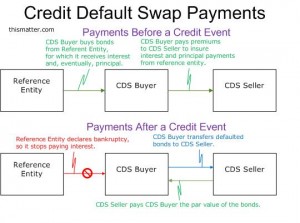
credit-default-swap payoutTraditionally, CDSs have been the favored hedge for corporate bond portfolios. However, regulatory restrictions and capital requirements for US banks stemming from the Basel III accords have crimped their ability to deal over-the-counter (OTC) credit derivatives. And several other rules and restrictions have further limited these banks from operating as traditional providers of liquidity and immediacy in the over-the-counter market.

To continue reading, please click here

BNP-PARIBAS-FINTECH-BLOCKCHAIN-CROWDFUNDING

BNP Paribas Gets Blockchain for Crowdfunding

(RaiseMoney.com)-French broker-dealer BNP Paribas “gets the joke” when it comes to fintech applications for equity crowdfunding and is embracing blockchain technology to advance their vision.

A subsidiary of BNP Paribas Group has announced a partnership that will find it leveraging blockchain technology to enable private companies to issue securities via equity crowdfunding.Revealed today, the partnership finds BNP Paribas Securities Services, its asset services division, working with investment platform SmartAngels on a pilot the firms said would be launched in the second half of 2016, pending regulatory approval.

In statements, BNP lauded the effort as a “major step” in advancing crowdfunding. The project will see BNP Paribas developing and managing a registry for shares in private companies using the blockchain that in turn will automatically register securities issued by SmartAngels.

Smart Angels will serve as a secondary market for shares registered on the BNP platform, a move the partners said would make it easier for startups and small businesses to access financing.

“Investor payments will be processed immediately and e-certificates will be issued to them straight away. Financial transactions made via the platform will therefore be performed simply, quickly, securely and for a lower cost.”


phillipe-ruault-bnp
Philippe Ruault, Head of Clearing, Settlement and Custody Solutions, BNP Paribas Securities Services

Philippe Ruault, head of product for clearing at BNP, emphasized his belief the program would accelerate trading in the private securities market.

“This is a major innovation for the custody and account-keeping of unlisted securities,” he said.

The project is not the first that finds a major financial firm seeking to leverage the blockchain as a way to ease aspects of the private securities process. The effort notably follows Nasdaq Linq, a pilot designed to allow entrepreneurs the ability to issue and manage private shares using a private blockchain system.

For the full story, please click here

canadian-exchanges-ETF

Canadian Exchanges Face-Off Over ETF Listings

Last week, Canadian upstart exchange Aequitas NEO announced its first ETF listing, and in response to that PR promotion, Toronto Stock Exchange (TSX), a subsidiary of TMX Group fired back with a slapshot, thanks to TD Asset Management (TDAM) listing and launching six new ETFs.

(TradersMagazine) Executives from TD Asset Management opened trading of its new exchange traded fund business at the Toronto Stock Exchange. Last week, TDAM’s six new passive ETFs began trading on TSX, including products designed to track the performance of Canadian fixed income markets as well as Canadian, U.S. and international equities.

ceo-tmx-group-eccleston
Lou Eccleston, CEO TMX Group (photo via Bloomberg)

“TSX is proud to welcome TD Asset Management ETFs to our Exchange. TDAM has been a great sponsor of the industry and our firm for many years,” said Nick Thadaney, president & CEO, Global Equity Capital Markets, TMX Group.

He added, “We have a rich history in supporting the successful growth of the ETF marketplace and we remain committed to serving this segment into the future. ETFs have become a vital part of Canada’s markets and a great example of the dynamic and diverse products we offer to investors.”

To celebrate the listing on TSX, Tim Wiggan, CEO, TDAM, joined Thadaney to open trading this morning.

As of February 29, 2016, there were 384 ETFs and exchange traded notes listed on TSX with a combined market capitalization of over $98 billion.

blythe-masters-bitcoin-blockchain

Blockchain Babe Blythe Masters in Repo Deal with DTCC

Blythe Masters, the former grand dame of derivatives for investment bank JP Morgan, who after a less-than-glorious exit from her senior role overseeing credit derivatives for House of Morgan and who reinvented herself as a blockchain babe and leads digital ledger startup Digital Asset Holdings, has proven that every cute cat has nine lives. In a press release issued this week, Depository Trust & Clearing Corp. aka DTTC, the industry-owned utility that processes transactions across the multi-$trillion repurchase agreement and government securities markets has entered into an agreement with the startup to test their blockchain application for use within the $2.6tril repo market sleeve so that lenders and borrowers across the often illiquid repo market can have a more efficient tool to track securities and cash flowing between counterparties.

Digital Asset Holdings, for which Masters is Chief Executive Officer, is considered one of the top 3 fintech companies focused on leveraging digital ledger technologies, the basic foundation of the cryptocurrency bitcoin. R3 Blockchain Group, whose investors include a consortium of 42 investment banks and financial service firms and is led by former inter-dealer broker David Rutter, along with Symbiont, the creator of Smart Securities and sponsored by merchant bank SenaHill Partners, are considered to be the other leading players in the space seeking to ‘institutionalize’ the value proposition of the technology that powers bitcoin.blythe-masters-marketsmuse

(WSJ)-Depository Trust & Clearing Corp., a firm at the center of Wall Street’s trading infrastructure, is about to give the technology behind bitcoin a big test: seeing whether it can be used to bolster the $2.6 trillion repo market.

DTCC said in a statement Tuesday that it will begin testing an application of blockchain, the digital ledger originally used to track ownership and payments of the cryptocurrency bitcoin, to help smooth over problems in the crucial but increasingly illiquid corner of short-term lending markets known as repurchase agreements, or “repos.”

Repos play a critical role in the financial system by keeping cash and securities circulating among hedge funds, investment banks and other financial firms.

DTCC, an industry-owned utility that helps settle trades in the repo market and elsewhere, wants to apply blockchain technology to the market, so that lenders and borrowers can keep track of securities and cash flowing between firms in real time.

To test blockchain’s ability to improve repo trading, DTCC has tapped Digital Asset Holdings LLC, a startup run by former J.P. Morgan Chase & Co. executive Blythe Masters. Earlier this year, DTCC invested in the firm focused on blockchain applications, along with a range of banks including J.P. Morgan, Goldman Sachs Group Inc., and others.


For the full story from WSJ, please click here

bats-global-etf-

BATS Global is Batty About ETFs-Buys ETF.com

While many people are “koo-koo for Cocoa Puffs”, BATS Global is batty about ETFs. On the heels of launching a dedicated electronic exchange platform for ETF products dubbed BATS Marketplace,  BATS Global Markets announced yesterday that is even more batty about ETFs and to prove it, the exchange operator is acquiring the ETF industry’s leading provider of exchange-traded fund news, data and analytics, ETF.com.

“This is a brand burnishing 201 case study for an otherwise staid electronic exchange industry as operators seek innovative, content-specific applications to distinguish themselves

(MarketWatch.com) Exchange operator BATS Global Markets said Tuesday it would buy ETF.com, a provider of data about the market for exchange-traded funds. BATS CEO Chris Concannon said the purchase “underscores [BATS’s] commitment to the ETF industry and our focus on providing unique, value-added content for issuers, brokers, financial advisors, market professionals and investors.”

ETF.com’s data will add to BATS’s existing proprietary market data and analytics offerings, according to a news release. BATS operates four stock exchanges in the U.S., which represent the largest venue for trading ETFs in the country when taken together, says BATS. Financial terms were not disclosed. The deal is set to close on April 1, according to the statement. The acquisition comes as Lenexa, Kansas-based BATS is trying to grow its ETFs listing platform. The exchange operator last year launched BATS Marketplace, offering to pay ETF providers as much as $400,000 to list on its exchange.

BATS listed 30 new ETFs on its US market last year─11 in December alone, more than any other US market, officials say─bringing its total ETF listings to 56, says the deal will expand the proprietary market data and analytics that BATS offers to support market participants in making “educated trading nad investment decisions.” ETF.com will become an independent media subsidiary of BATS Global.

best-execution

Best Execution Wack-A-Mole Aims at Wholesalers

When it comes to gauging best execution, that exercise is akin to a game of whack-a-mole when calculating in the role of wholesalers aka over-the-counter market-makers whose business model includes leveraging maker-taker rebate schemes. MarketsMuse credits below excerpted observations from TabbForum and courtesy of Stanislav Dolgopolov, Decimus Capital Markets, LLC

(TabbForum) Compliance with the duty of best execution is typically focused on customer-facing brokers, but the stringent standard of best execution may pop up several times in the transactional chain. One critical issue already getting—and deserving—more attention is the extent to which the duty of best execution applies to off-exchange market makers, commonly referred to as ‘wholesalers’ or ‘internalizers,’ and whether conflicts of interest are keeping them from meeting these obligations.

One illustration of potential conflicts of interest is monetization of maker-taker arrangements for certain types of orders – typically, nonmarketable limit orders – by off-exchange market makers through secondary routing, which may potentially come at the expense of execution quality, given that a substantial portion of orders directed to them consists of such orders. Furthermore, a typical major player in the wholesaling segment is in the spotlight to demonstrate the adequacy of execution within its affiliated dark pool(s), given a bevy of concerns, such as toxicity, slowness, or leakages of customer order information. Yet another consideration from the standpoint of the very definition of “best execution” is whether there are self-interested or otherwise avoidable delays counter to the requirement of prompt execution.

Finger-pointing in connection with achieving and maintaining execution quality is not necessarily an easy task. Compliance with the duty of best execution is typically focused on customer-facing brokers, as illustrated by the level of scrutiny of retail brokerages, including lawsuits, in connection with payment for order flow and maker-taker arrangements. At the same time, the stringent standard of best execution may pop up several times in the transactional chain. One critical issue already getting—and deserving—more attention is the extent to which the duty of best execution applies to off-exchange market makers, commonly referred to as “wholesalers” or “internalizers.”

This assumption of the duty of best execution may be rooted in contractual arrangements—sometimes called “order handling agreements”—between off-exchange market makers and customer-facing brokerage firms. Pursuant to the applicable agreement, an off-exchange market maker may in fact discharge agency-based functions in addition to trading in the principal capacity. By contrast, market making on securities exchanges has been “de-agentized” in the sense that designated market makers have been relieved of their traditional agent-like duties to investors. In fact, some order handling agreements specifically mention the best execution standard. Even when this standard is not spelled out, the scope of the applicable relationship is likely to bind that off-exchange market maker as a true “executing broker” subject to the duty of best execution.

To read the entire article, please click here

bny-mellon-mischler

World’s Biggest Bank Gets It; Gives It Back

BNY Mellon ‘Gets It’ and Also Gives It Back.

With close-on $29Trillion in deposits and $1.3Trillion in AUM, BNY Mellon (NYSE:BK), the oldest bank in the U.S. is not just the country’s biggest, it ranks as one of the world’s biggest banks. Hundreds of financial industry professionals now working across the financial markets ecosystem are alumni of BNY Mellon, long-recognized as the top training ground for those who aspire to long-term professional careers within financial services.

While many “BNY” alum (including MarketsMuse senior editor) fondly recall an on-boarding process in which mentors made humorous reference to Alexander Hamilton’s orders to his top executives immediately prior to his ill-fated duel with Aaron Burr (“Don’t do anything until I return..”), most followers of BNY Mellon know that its culture is driven by perseverance and a focus to make sure no stone be left un-turned in the course of overcoming a challenge. In that spirit, a young, London-based BNY Mellon exec by the name of Charlie Thompson, a former professional Rugby star who cashed-in his sports career in favor of banking, deserves a hero’s award for re-uniting an industry colleague and highly-decorated Vietnam War hero with an invaluable piece of his personal history.

While Thompson was on holiday last year touring Vietnam, he came across a souvenir hut hawking assorted items that included a set of US military dog-tags. Intrigued, Thompson purchased the tags with the goal of hopefully tracking down the owner and/or family members and returning them. It turns out those dog-tags had been lost nearly 48 years ago by former US Marine Infantry Officer Rick Tilghman, who while serving in Southeast Asia, was awarded not one, but two Purple Hearts and The Bronze Star (with Valor).

Making the story more inspiring, the new personal bond between Thompson and Tilghman is coincident to a long-standing bond market relationship between Thompson’s employer and Tilghman’s firm, the boutique investment bank Mischler Financial Group (the industry’s oldest minority broker-dealer firm owned/operated by Service-Disabled Veterans), where Tilghman, now one of the municipal bond industry’s elder statesmen, oversees the firm’s Public Finance Underwriting group.

colleen-krieger-bny
Colleen Krieger, BNY Mellon

To their credit, BNY Mellon, long an advocate of Veteran-centric initiatives, has made hay with this story and since went to great lengths to help Thompson coordinate a formal return of Tilghman’s dog-tags, and along the way, produced a documentary story that has since been profiled by multiple news media outlets, including this week’s 10-minute interview of Thompson and Tilghman by Fox and Friends and broadcast via multiple FOX News affiliates.

Here’s the corporate documentary profiling the story that was produced by BNY Mellon. Rolling credits are not included, but a special salute goes to Colleen Krieger, Associate Director of Corporate Communications for BNY Mellon.

rebate-schemes-market-structure-marketsmuse

Pay-to-Play Rebate Schemes Confuse Smartest Traders

Within the context of market structure, the ever-evolving rules of the road for those attempting to navigate how and where to secure best pricing when executing equities orders has become so convoluted thanks to pay-to-play rebate schemes, its not only the curators at MarketsMuse who are scratching their heads, even the most sophisticated traders from both the buy-side and sell-side are confused.

As noted in today’s NYT article “Stock Exchange Prices Grow So Convoluted Even Traders Are Confused” by  reporter Nathaniel Popper, one of the sharpest knives in the drawer when it comes to distilling both technology and regulatory policy issues that impact financial markets, “computer-driven American stock markets have become so complex that any moment in time more than 800 different pricing possibilities are being offered to trading firms across 12 official exchanges, according to a report prepared by Royal Bank of Canada (RBC).”

Here are some of the noteworthy extracts from Popper’s piece:

mehmet-kinak-t.rowe-price
Mehmet Kinak, T.Rowe

“The level of complexity has grown to such an extent that it is unknown to most market participants,” said Mehmet Kinak, the head of electronic trading at T. Rowe Price Group, and a client of RBC with which the research has already been shared. “Instead of finding natural buyers and sellers, we’re finding intermediaries who come in and are benefiting from the complexity.”

“When we trade we don’t even know what it will cost us,” said Rich Steiner, the head of electronic trading strategy at RBC.

The prices are far from the only factor introducing complexity into the markets. Twelve public exchanges are now in operation, compared to a time when the markets were largely ruled by one: the New York Stock Exchange.Then there are the dozens of so-called dark pools, where stocks can be traded privately away from the public exchanges.

All of these trading venues offer many different types of orders that determine how and when a stock can be traded. A 2014 research report identified 133 unique order types, including some for particular times of the day and others for trades of a particular size.

RBC and other critics of the stock market structure argue that the rebates given out by exchanges can skew the incentives of brokers and banks, encouraging them to trade where they can get the largest rebate, rather than where they can get the best price for their client.

The pricing structures that RBC details in its new report are a result of the efforts by exchanges to calibrate the rebates they offer to some customers and the fees they charge to others.

In one example given in the report, the BATS-Y stock exchange — one of four stock exchanges run by BATS Global Markets — sent out a fee notice at the end of March 2014 announcing that it would offer 15-thousandths of a cent to traders buying certain stocks, thus bettering the 14-thousandths of a cent that Nasdaq BX had been offering. Fifteen minutes after the BATS-Y filing, Nasdaq made its own filing matching the new BATS-Y price. The next morning, BATS-Y filed again, increasing its offer to 16-thousandths of a cent.

Between 2012 and 2015, RBC found 362 filings with regulators announcing changes to trading fees, with some of the filings including multiple fee changes. The number of pricing tiers proliferates quickly because each tier can apply to similar trades in different ways depending on how frequently a trader uses a particular exchange.

Vimal Patel, who oversaw the research at RBC, said that he had no idea how tangled it had become until he began trying to sketch it out last summer. “It snuck up on people that the world is this complicated,” he said.

According to Popper, the new research from RBC is likely to strengthen the hand of an upstart company, IEX, that is currently asking regulators for approval to become an official stock exchange. Although IEX Founder/CEO Brad Katsuyama is a alumni of RBC, the report issued by the bank and scheduled to be submitted this week to a Senate Committee investigating market structure issues makes no reference to IEX.

For Popper’s story published by the NY Times, click here

shot-across-bow

Symphony Pact With FlexTrade-Shot Across Bloomberg Bow

Symphony, the Wall Street-backed secure messaging platform first designed to displace Bloomberg LP’s most ubiquitous feature and further reduce the Street’s dependency and technology costs synonymous with having a Bloomberg terminal, has struck another blow in the bow of Bloomberg’s boat thanks to the consortium-owned deal with electronic execution system provider FlexTrade.

If not widely known outside the world of trading systems vendors, EMS provider FlexTrade does have a global footprint and is utilized by buy-side managers as well as sell-side brokers, but when compared to Bloomberg’s terminal farm of nearly 300,000 subscribers, it is otherwise a minnow compared to Bloomberg’s being a whale in the ocean of institutional electronic execution offerings. That said, the news below from FlexTrade, in which they have just merged order management functionality with Symphony’s messaging applications is likely to cause Mike Bloomberg spending more than 15 minutes thinking about the ramifications of below story while flying his private jet down to the Bahamas this weekend. The story headline from Markets Media may be dry to some, but for those following Symphony’s encroachment, it is wetting the mouths of sharks.

(Markets Media) FlexTrade Automates Blotter Communication

Execution-management system provider FlexTrade has integrated Symphony’s secure messaging platform with its trading platform.

“The integration lets clients communicate directly from their trading blotter over Symphony in a secure and compliant way,” said Andy Mahoney, director of business development for FlexTrade UK.

Driving the integration was a sea change in traders’ behavior across the Americas, Europe and Asia that FlexTrade noticed, according to Mahoney.

andy-mahoney-flextrade
Andy Mahoney, FlexTrade

“People want to be able to communicate from their blotters,” he said. “Obviously, integrating Symphony into the FlexTrade platform is the next step in that.”

FlexTrade clients are free to decided how they wish integrate Symphony into their current workflow.

Some of the basic capabilities include firing off automated messages if a specific set of criteria is met.

“For example, if brokers fill your orders outside the spread, clients can trigger a message asking the brokers why they filled the order outside of the spread,” said Mahoney. “Or if you get a lit execution on a dark algo, it also can trigger an automated message to the broker.”

FlexTrade also plans to add the ability to search for information and research on specific issues from the blotter, capture conversations in the platform’s FlexTCA transaction-cost analysis tool as well as support fixed-income liquidity discovery, inventory distribution and price negotiation in the coming months.

To continue reading the story from Markets Media, click here

sec-chair-white-marketsmuse

SEC Chair White: “I Have A Dream..”

SEC Mary Joe White has a dream, and even if she aspires to leverage the inspirational outlook of  Dr. Martin Luther King, securities industry members are debating whether her dream could prove to be a reality any sooner than the civil rights agenda expressed by Dr. King so many years ago.  In a series of comments during the past several weeks from Chairperson White regarding the SEC’s agenda for the remainder of her tenure as President Obama’s designated SEC Chairperson, Ms. White, who is operating with only 3 of 5 Commissioners until two open vacancies are filled before the Second of Never,  she is vowing one of the top three items on her list includes “better understanding exchange-traded funds aka ETFs before the SEC approves prospectuses.” That makes sense.

One only wonders why that elementary concept had never occurred to any one previously—despite repeated calls from among others, former SEC Commissioner Steve Wallman (1994-1997) who has long questioned the approval process for many of the complex exchange-traded products the SEC has rubber-stamped, including inverse and commodities-related products that even professionals often do not understand.  Since his departure from the SEC, Wallman has proven adept at doing the right things while serving at the helm as Founder/Chairman/CEO of the investment firm Foliofn.com.

Other matters of importance according to White include “the desire on part of SEC to introduce “fiduciary definitions for registered advisers and brokers..” which in plain speaks means : White’s agenda is to figure out how to completely change the culture of the securities brokerage industry by forcing people to be ethical and moral. MarketsMuse sources have indicated White is proposing to have those folks swear an oath that says:

“My first obligation is to protect my clients’ interest above all else and to make sure I never even think of trying to sell them something that might be inappropriate for their goals or possibly even toxic—despite the fact my office manager says I have to sell house product only or I’m out of a job. After I meet that first obligation, my second obligation is to then make enough money to pay for my kids college and have enough left over for that condo in Florida.”

Insiders familiar with White’s agenda have told MarketsMuse that she has acknowledged her seemingly altruistic mission is not without challenge or headwinds given that the “securities industry at large is much like the NRA when it comes to influential prowess.”

Directly and indirectly, Wall Street firms and its executives contribute hundreds of millions of dollars every year to lobby SEC Officials and members of Congress(which the SEC reports to) on behalf of their interests—which presumably includes two big drivers that have driven the investment industry since the days of Joe Kennedy Sr.: (i) selling investment vehicles that look great on paper and in marketing collateral [even if they might or might not prove to be toxic at some point and might or might not be appropriate for a specific individual given that people’s moods change a lot] (ii) how to pay the mortgage on the brokers’ first house, the $200k for each of their kids college tuition bills, the country club memberships that provides venues in which to sell those investment products,  sharpen up the golf game, and of course, pay for the second and third homes, etc etc.

Another item on White’s laundry list is to expand the  exam program for registered brokers and advisers. Currently, 10% of the nearly 12,000 advisers sit and take ‘refresher tests’ that are abridged versions of the Series 7—an exam that has approximately 40% brokers FAIL the first time and 30% fail the second time. Some could argue the test is maybe too difficult, given the national average score is 67 vs. a passing grade of 72. Or, one could argue the barrier to entry to become a registered broker or adviser is simply being a good test taker. Idiots and Muppets can get licensed, as long as they take 8 practice exams the night before the actual exam and memorize the correct answers. So, Chairperson White wants more folks taking more tests; a good thing for the SEC because this is big a revenue-generator for the Agency—which has repeatedly claimed it does not have enough money to even pay for air conditioning in its Washington DC office. Staff members have said this alone is vexing, given that SEC examiners and enforcement agents have become accustomed to keeping windows wide open five months of the year and continuously grapple with files on their desks blowing out of their windows and many of those files pertain to complaints filed by investors and updated paper notes sent by from enforcement agents in the field via courier pigeons.

Courtesy of  an admittedly more illustrious news media outlet than MarketsMuse might be, the following is ‘official coverage from InvestmentNews.com:

(InvestmentNews) Despite missing two of its five members, Securities and Exchange Commission Chairwoman Mary Jo White said Friday the agency will forge ahead on rules to raise investment-advice standards and enhance oversight of advisers.

“At the moment, as you know, we are a commission of just three members, but — as has occurred in the past — we can carry forward all of the business of the commission,” Ms. White said at the Practising Law Institute conference in Washington. “And, while we look forward to welcoming new colleagues, Commissioners Stein, [Michael] Piwowar and I are fully engaged in advancing the commission’s work.”

The Obama administration has nominated Republican Hester Peirce and Democrat Lisa Fairfax to replace two members who have departed the SEC, Republican Daniel Gallagher and Democrat Luis Aguilar, but the Senate has not yet begun the confirmation process. Continue reading

bond-etf-trading

Bank Trading Desks Merge Bonds and ETFs

Corporate Bonds and exchange-traded funds is a combination that first seemed counter-intuitive to the select universe of traders who are actually fluent in both corporate bond trading and equity trading; two practice areas that are distinctively different. “Stocks are bought and bonds are sold” as they used to say, and the nuances of trading these distinctive asset classes in the secondary marketplace have long been at odds with each other.

This explains why fixed income traders from both the buy-side and sell-side rarely even knew their equity-trading counterparts, no less engaged in cross-asset trading. But thanks to shrinking trading profit margins, Wall Street trading desks now ‘get the joke’, and per story below, are bolstering their business models.

(REUTERS) Feb 18 Wall Street banks are ramping up businesses that trade exchange-traded funds full of bonds, a bright spot of growth at an otherwise bleak time for trading but one that may carry unappreciated risk.

Barclays PLC, Credit Suisse Group AG and Goldman Sachs Group Inc have all created special teams to make markets in bond ETFs. The teams include staff across stock and bond markets, since the ETFs trade like stocks on stock exchanges, but their underlying securities are bonds.

All told, 12 to 15 banks now have a presence in the business, whereas a few years ago almost none did, said Anthony Perrotta, global head of research and consulting at TABB Group.

“There are a lot of institutions that, even though they might be retrenching in fixed-income trading, are looking at ETFs as a way to galvanize their business,” said Martin Small, who oversees U.S. operations for BlackRock Inc’s iShares unit, which is the largest ETF issuer.

Although these businesses are sprouting up across Wall Street, they are unlikely to make up for huge profits banks earned during the glory days of bond trading, at least not anytime soon.

Investors pay banks 0.01 percent to 0.03 percent to trade a bond ETF, according to TABB Group, compared with 1.03 percent for an individual bond. Traders say they are hoping to make up for piddling margins by selling more of the product, since the ETF business is a bulk-volume one that is rapidly growing.

The sales push comes after years of pressure from leading ETF creators like BlackRock and State Street Corp to make markets for the bond ETFs. Those firms rake in billions of dollars’ worth of revenue from ETFs each year, and view bond ETFs as a way to grow their own businesses.

Firms that create ETFs need banks to act as intermediaries for sales, and also to ensure that prices are in sync with underlying securities. Before banks entered the market, trades were handled by market-makers like KCG Holdings Inc, Cantor Fitzgerald and Susquehanna Capital Group, who have been in the business for years.

As Wall Street has warmed to bond ETFs, the market has quickly grown. Assets under management in the U.S. rose 44 percent to $372 billion at the end of January from $258 billion a year earlier, according to fund research service Lipper. That represents about 19 percent of the broader $2 trillion U.S. ETF market.

While the bond-ETF boom may be good for Wall Street, it is not without risk.

It comes at a time when liquidity in the corporate bond market has shriveled due to new rules that require banks to hold a lot of capital against those securities. As a result, banks avoid buying bonds from investors unless they can resell them quickly, and do not maintain much inventory for interested buyers.

Despite their holdings, bond ETFs trade more like stocks, on stock exchanges, so they are not facing the same type of liquidity issue. But it is unclear how they will perform if investors rush for the exit all at once, or if markets come under serious stress. During the Aug. 24 “flash crash,” for instance, some ETFs failed to trade properly.

The full story from Reuters is here

geared-etfs-sec-marketsmuse

SEC Aims To Ban Geared ETFs

The US SEC apparently has its cross-hairs on so-called ‘geared ETFs,’  those high-testosterone, levered instruments that incorporate derivatives so as to deliver an advertised 2x or 3x return for certain strategies versus a typical 1:1 correlation provided by plain vanilla exchange-traded funds.  The SEC proposal would effectively ban the use of those products altogether.

As reported by Ari Weinberg in his most recent column in Pensions & Investments,  SEC staffers are holding further rounds of reviews of proposed rule changes that could effectively eliminate triple-leveraged and triple-inverse ETFs, which totaled 66 funds and $11.3 billion in assets under management as of Jan. 15, according to research firm XTF. Excluding exchange-traded notes, which are not subject to the Investment Company Act, the entire leveraged and inverse ETF universe includes 195 funds and $30.1 billion in assets.

This is not to suggest that  ‘inverse return’ exchange-traded funds are bad (even if many are actually completely unsuitable for most investors),  it’s just that nobody at the SEC seems to understand how they work, despite the fact these products need first be approved by the SEC before they can be issued, and despite the fact the SEC has given its green light to the these derivative-powered exchange-traded notes aka ETNs since they were first conceived and popularized  nearly 15 years ago.  According to one senior investment manager executive  overseeing nearly $10bil AUM and who asked not to be identified in this article, “..The proposed rules being discussed now simply proves that the SEC need not ever understand a financial product before they rubber-stamp the issuance of a financial instrument that would fall under SEC oversight.” He further added, “Its hard to say which is more broken, the SEC or products they allow to be sold to institutional and retail investors.”

“The SEC is responding to a combination of concerns, some of which are well founded and some of which are less well founded. There’s a belief that ETFs create risk because of asset class exposures, high trading volumes and market structure issues,” says Edward Baer, counsel at Ropes & Gray in San Francisco, who recently served as chief legal officer for BlackRock (BLK) Inc. (BLK)’s iShares business.

Geared ETFs, offered separately by ProShares and Direxion Investments, are designed to track two or three times the daily return (or inverse) of an underlying index. Awareness of the products peaked during the volatile days of the financial crisis, but both FINRA and the SEC have repeatedly voiced concerns that the products are misunderstood by many investors or used improperly.

As noted in the P&I story by Ari Weinberg..

In turn, both the SEC and FINRA have stated that regulatory examinations in 2016 will focus on the knock-on effects and risks to authorized participants in the ETF ecosystem. This network of investment banks and trading firms greases the wheels of ETF trading by creating or redeeming shares in the primary market and buying or selling in the secondary market. Their trading is motivated by the profit potential in arbitraging away price discrepancies in the ETF share price and the underlying assets.

“AP activities may … result in pressure on the financial integrity of broker-dealers in some conditions and this, in turn, could impair the liquidity provision function the broker-dealer plays when acting as an AP,” FINRA wrote in its annual examination priorities letter.

Similarly, the SEC’s office of compliance inspections and examinations said that it would focus on ETF compliance with their exemptive relief, as well as sales, trading, and disclosures involving ETFs.

For the full story from P&I, click here


junk-bond-etf-liquidity

Junk Bond ETFs-The Liquidity Debate Goes to SEC

MarketsMuse ETF and Fixed Income curators have frequently spotlighted the ongoing debates as to whether corporate bond ETFs, and in particular, junk bond-specific exchange-traded-funds pose special risks. Some argue that a liquidity crisis could unravel the high yield bond sector if/when institutional investors decide that risk of recession continues to ratchet higher, leading all of those investors to run for the exit at the same time, and in turn, causing a reverberation across the ETF market. The counter side to that thesis is that corporate bond ETFs (NYSE:HYG among them) are insulated from the risk of a catastrophe that might envelope the underlying components (the actual bonds themselves). One thing that is certain is that the US SEC is not certain, and they’ve raised the volume on this topic.

Adding light to this topic is WSJ columnist Ari Weinberg, someone who is arguably one of the best educated members of the 4th Estate when it comes to ETFs, and Monday night column deserves our kudos and sharing select extracts…Roll the tape..

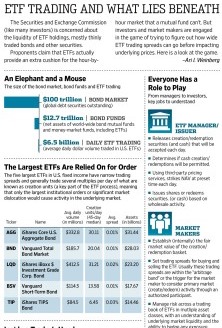
junk-bond-etf-liquidity-crisisMost investors in mutual funds and exchange-traded funds probably don’t worry much about liquidity. After all, fund shares can be bought and sold easily anytime online, and trades are completed in one to three business days.

But there is another layer of trading—the trading the funds themselves do when a wave of selling by investors requires the funds to sell some of their assets—that has the Securities and Exchange Commission worried about liquidity. And the commission wants investors to be more aware of the risks it sees.

The issue is particularly pertinent for the fixed-income fund market, because assets that some of those funds hold are very thinly traded. Here’s a look at what’s involved.

Deciding between the two isn’t always straightforward. Here’s help clarifying the differences and similarities.

The SEC’s concern is that some mutual funds and ETFs might hold too many securities that aren’t easy to sell quickly. As a result, the funds might not always be able to adjust their holdings without “materially affecting” the funds’ net asset value per share, the commission said in its September announcement of proposed new liquidity-risk management rules. In other words, selling a substantial amount of illiquid securities quickly could drive down their price, resulting in a big loss for a fund, lowering its value.

Among other things, the proposed rules would require funds to categorize the liquidity risk of their holdings according to how many days it would take to sell the assets without greatly affecting their market price, and disclose those risk assessments to investors. The SEC also proposed to strengthen and clarify an existing guideline that no more than 15% of a fund’s assets should be held in securities that would take more than seven days to convert to cash.

Several ETF issuers, as well as the Investment Company Institute, a fund industry trade group, have said in comment letters that the SEC’s proposals aren’t relevant to most ETFs, because the funds are structured differently from mutual funds.

Mutual-fund investors buy and sell their shares directly from or to the fund. So mutual funds regularly need to sell assets on the open market to pay investors who are redeeming their shares. But ETF shares are traded among investors, not between investors and the fund. So most ETFs usually don’t have to sell assets when investors sell their shares, because the shares are being bought by other investors, not being redeemed by the fund.

ETF shares are only created or redeemed, and the underlying assets bought or sold, when doing so is necessary to keep the market price in line with the net asset value of the fund’s holdings. Those transactions are done between the funds and financial institutions called authorized participants, or APs, which often also serve as market makers in the ETFs and other securities.

Here is how it works in most cases: If heavy selling is driving an ETF’s market price below the fund’s net asset value, a market maker, acting through an AP or acting as an AP itself, will buy up shares and deliver them to the fund in the form of a so-called creation unit—taking them off the market—in return for an equal value of the underlying assets held by the fund. It’s then up to the trading firm to decide if it wants to hold those assets or sell them.

The argument ETF issuers are making to the SEC is essentially that this process insulates ETF investors from the dangers of a fund having to sell illiquid securities on the open market.

The opposing argument, made by the SEC and those who favor the proposed new rules, is that there is a risk that the AP might not be willing to take on assets that are very hard to sell quickly, throwing a wrench into the whole process of keeping the fund’s net asset value in line with its share price. That would be reflected in a widening of the bid-ask spread for the ETF—the difference between the price investors can get for selling shares and the higher price they would have to pay to buy the shares.

The concern that this could happen to a fixed-income ETF is based in part on changes in recent years in the fixed-income markets. Financial institutions in general are more averse to the liquidity risk that some debt securities pose, in part because of increased regulation governing the institutions’ risk exposure. Investment banks, for instance, hold 80% less corporate bond inventory than a decade ago.

Ultimately, according to many traders and market participants, concerns around ETFs and fixed-income holdings will only be mitigated when there is more transparency in the market, as more securities are quoted and traded electronically. Currently, only about 10% to 25% of the secondary trading in corporate bonds—depending on the amount of each bond in the market and the issuer’s credit quality—is electronic. The rest is done via online messaging and phone calls.

Continue reading Ari Weinberg’s dissertation directly via the WSJ


global-macro-view

Global Macro Guru Says: Look Out Below

MarketsMuse curators are often most inspired by views expressed by those dedicated to interpreting and positing financial market outlooks via a global macro lens. This ‘style’ requires a disciplined process and for those who are best in the practice of this dark art, the projections are often prescient. With that, we point to opening commentary courtesy of  global macro guru Neil Azous via  ‘Special Sunday Night Edition’ of “Sight Beyond Sight”, a daily publication produced by global macro think tank, Rareview Macro LLC and one that is followed by many of the top hedge funds across the globe.

neil azous-global-macro
Neil Azous, Rareview Macro

The majority of conversations over the weekend were centered on the breakdown in the momentum factor in US equities. Given how deeply embedded this factor is into all strategies built over the last 18-months, the tentacles are far reaching, including observations on the value versus growth style, large versus small capitalization, quantitative strategies, the performance of TMT funds, defensive rotation, etc.

Since this newsletter is forward-looking – sight beyond sight – we will not rehash those conversations or illustrate the back-tests of past episodes of momentum unwinds that have been published.

However, there are a few important observations to recognize.

Firstly, the world’s most sought after top-down strategists are united in calling for the momentum unwind to continue. In fact, some were quick to begin to take victory laps on their forecasts for this event so the last thing they want to do is relinquish their trophies so soon. At this point, vanity is all that is left for some even if their broken clock is right twice per day.

Secondly, a lot of ink has been spilled over the last six months on the narrow market leadership – FANG, NOSH, Top 10 basket, Top 20 basket, etc. We highlight this because unlike the sell-off in January that was driven by hedging and index futures flows this sell-off is being driven by the long selling in the narrow leadership – single stocks – which makes up a disproportionate amount (i.e. 40-45%) of the S&P 500’s market capitalization. Put another way, there is no hedge to this type of selling except to reduce risk outright.

Thirdly, there are a lot of kids with rulers out there drawing straight lines on a chart. In fact, we did not even have to data mine very hard at all to find key breaks in many relationships. While these illustrations are subjective depending upon what technical analysis discipline you subscribe to, the fact is that for the moment they are self-fulling to the momentum unwind narrative and you have to live with them for a while. We have included a few for your amusement in the Top Observation section below.

In our experience, there are two types of momentum unwind.

The first one is the normal run-of-the-mill unwind due to irrational exuberance in valuations and an extended positioning in consensus strategies.

The second one is related to changes in cycles.

It is a bad combination when all three – valuations, positioning, and cycles – converge as is the case now, in our opinion.

Regardless of which bucket you want to place the current episode into, the reality is that these exercises tend to last 2-3 months, and in some cases when the world is really in bad shape, as many currently feel it is, can last 6-months or longer.

The key point here is that to expect a resumption of momentum or a recovery of that factor’s leadership this early in the unwind, especially considering the PnL duress in the professional community is currently more violent than the losses suffered in January, would be misguided.

Put another way, if there is a momentum strategy, style relationship, market capitalization, sector rotation, you watch daily, and it is down or has reversed by 5-10%, call us when it is down or has reversed by 20-30%, and we will take a look at it.

Finally, ask yourself this question:

If the EURO STOXX 50 Index (SX5E), German DAX (DAX), NASDAQ 100 (NDX), Russell 2000 (RTY), and Facebook-Amazon-Netflix-Google (FANG) all made new “closing lows” for 2016 last Friday, then is it more likely that the next move for global risk assets is a bounce or that the Nikkei 225 (NKY) and S&P 500 (SPX) will play catch up?

The answer to that question, along with other insights can be found by those who read the entire Sunday Night Special Editor of Sight Beyond Sight. To do so, please go directly to Rareview Macro’s archive section via this link (Subscription Required, but Free Trial Subscriptions are still being offered)