MarketsMuse Fixed Income Dept. is keeping tabs on industry updates and re-distributes the following news release courtesy of Mischler Financial Group, the financial industry’s leading minority brokerdealer owned and operated by service-disabled veterans.
Stamford, CT—July 22, 2015—Mischler Financial Group, Inc., the financial industry’s oldest and largest minority investment bank and institutional brokerage owned and operated by Service-Disabled Veterans announced that Patrick Beranek, a 20-year industry veteran and most recently the head of Asset-Backed trading for Royal Bank of Scotland (“RBS”) has joined the firm’s capital markets division as Managing Director, Structured Products.
Mr. Beranek previously ran asset-backed trading and syndicate for Mizuho Financial Group Inc. and Bank of America Corp. Prior to those senior sell-side roles, Mr. Beranek was a portfolio manager for Federal National Home Mortgage Corp (FNMA). In this newly-created role at Mischler Financial, Mr. Beranek will oversee primary market activities of structured products. He will report to Robert Karr, Mischler’s Head of Capital Markets.
In connection with the latest expansion, Mr. Karr stated, “The ABS market has undergone a dynamic reset during the past several years, creating new opportunities. Given current economic drivers, a longer-term interest rate outlook and the demand for quality, non-core fixed income instruments, we’re confident that Pat will prove instrumental in the course of elevating Mischler’s role in the primary market for structured products and help bring compelling opportunities to our institutional investor base.”
Added Dean Chamberlain, CEO of Mischler Financial, “We are very pleased to add Pat to our team. Having worked with him before, I know that he has a unique skill-set that will further bolster our structured finance capabilities.”
For the full story, please visit the Mischler Financial Group website via this link
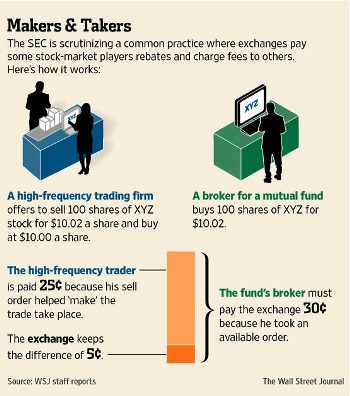
On the heels of the recent NYSE ‘outage’, which actually had little impact on overall equities trading volume, but did lead to volume spikes away from the NYSE and at competing exchanges across the fragmented marketplace, the volume also increased with regard to spirited discussions about market structure. And, whenever talking about market structure, the “rebate debate” insofar as “maker-taker” rebate and fee schemes remain a front burner topic. It is no surprise that many (but not all) sell-side brokerdealers are characteristically in favor of these complex Chinese menus offered by the assortment of major exchange venues and dark pool operators. After all, brokers are ever more dependent on these ‘rebates’ as the race to zero in terms of commission rates paid by institutional customers continues to eat into executing broker income. To counteract the business model impact on BDs, savvy executing brokers have [for a number of years] been making up for lower rates via capturing offsetting revenue from routing customer orders to those bounty-paying trade execution platforms.
On the other hand, nobody should be surprised that an increasing number of institutional investment managers from the buy-side are beginning to “get the joke”, but they aren’t laughing as many realize that brokers are effectively double-dipping by charging their customers a commission and also pocketing kickbacks from competing execution venues that pay those brokers to help light up their screens and provide so-called actionable liquidity execution.
A comprehensive database of global brokerdealers in more than 30 countries, including the US is available at www.brokerdealer.com
To wit, and in our continuing coverage of this topic, MarketsMuse curators spotlighted this week’s story from buy-side publication Pensions & Investment Magazine, which profiles the heightened concern on the part of buysiders and the growing number who are expressing their angst with the SEC, the agency that is ostensibly supposed to ensure fair market practices and protect the interests of public investors. Below are select take-aways from the P&I story.
The Buy-Side Says: “Along with conflict-of-interest issues with rebates, other concerns like increased transaction costs and lack of transparency have added to the complexity of today’s market structure,” says Ryan Larson, RBC Global Asset Management. Added Larson, “Whether it’s SEC mandated, or better yet, driven from market participants themselves, I think it’s time to finally address the elephant in the room and start thinking about possible alternatives to the maker-taker model. … It’s not just the buy side that has been calling for a pilot on maker-taker. It’s the sell side, some of the exchanges, Congress, even members of the (SEC) as well. When you see that diverse of a group calling for change, I think it suggests something very important — whether maker-taker is the right approach. This could be one of the most impactful tests ever taken up in market structure.”
The Not-So-Subjective Market Data Vendor Says: “The whole point of maker-taker is to incentivize display of liquidity in lit markets,” said Henry Yegerman, director of trading analytics and research at financial data provider Markit Group Ltd., New York. “Market participants who place trades that rest passively in a venue, and so add liquidity, get a rebate. Investors who aggressively cross the spread to access that liquidity pay a fee to do so.” Institutional investors that are looking to buy or sell large blocks of stocks “are frequently takers of liquidity,” he said.
The Altruistic Sell-Side Perspective: Joseph Saluzzi, partner, co-founder and co-head of equity trading of Themis Trading LLC, a Chatham Township, N.J.-based agency broker for institutional investors said the link between liquidity and maker-taker doesn’t exist. What maker-taker does increase, Mr. Saluzzi said, is volume. “Liquidity and volume are two different things,” Mr. Saluzzi said. “Maker-taker creates volume, and a lot of that is artificial.”
Mr. Saluzzi said liquidity access is not helped through maker-taker, but by changes in a fragmented market structure that would reduce the number of trading venues. “Liquidity is not helped by rebates, but by less fragmentation,” Mr. Saluzzi said. “Maker-taker is the linchpin of the problems with the market. It’s a relic of a system that was around 15 years ago.”
The Exchange Perspective: Not Everyone Agrees: IEX, the dark-pool operator whose ATS platform is now awaiting SEC approval to operate as a regulated exchange is perhaps the most outspoken critic of maker-taker fee/rebate schemes; customers are charged a flat rate commission irrespective of how an order interacts with prevailing bid-quotes. The New York Stock Exchange came out against maker-taker rebates in testimony by exchange executives in 2014, while Nasdaq Global Markets is running a pricing test program that lowers rebate pricing for select stocks to gauge the effects on liquidity. In two reports this year on the test, Nasdaq has said the lower rebates have had a negative effect on liquidity.
At the other end of the spectrum, executives at BATS Global Markets Inc., which is perhaps the second largest equities exchange as measured by volume, don’t support an outright maker-taker ban and think the rebate paid to liquidity providers matters, “particularly with less liquid securities,” said Eric Swanson, general counsel at BATS, Kansas City, Mo.
[MarketsMuse editor note: Mr. Swanson is a former SEC senior executive who served as Asst. Director of Compliance Inspections and Examinations during the same period of time that his wife Shana Madoff-Swanson, the niece of convicted felon Bernie Madoff, received millions of dollars in compensation while she served as head of compliance for Bernard L. Madoff Investment Securities. According to Wikipedia, Swanson first met Shana Madoff when he was conducting an SEC examination of whether Bernie Madoff was running a Ponzi scheme. Ms. Madoff-Swanson’s father Peter is the brother of Bernie Madoff and is currently serving an extended sentence in a federal jail while Uncle Bernie is serving a 150-year sentence.]
How big are ETFs these days? Even Kevin O’Leary, aka “Mr. Wonderful” of ABC’s “Shark Tank” is getting into the game. On Tuesday, O’Leary was on the NYSE floor to launch the O’Shares FTSE US Quality Dividend ETF, (ARCA NYSE:OUSA): a basket of high-dividend stocks.
But he’s not doing this just to enter the crowded ETF space, which already has 1,700 ETFs and more than 50 ETF providers.
As noted by the coverage from CNBC, “Mr. Wonderful” is entering the exchange-traded fund world as an Issuer because he needed an investment vehicle for the equity portion of his family trust, which he started in 1997. O’Leary claims he wanted an investment vehicle that was rule-based, first and foremost, so no one would tinker with it.
And he wanted dividends. Why dividends? As O’Leary accurately opines, 70 percent of the returns in the stock market over the past decade or so have come from dividends.
But O’Leary did not just want to buy a basket of the highest-yielding ETFs. You can get that already with Vanguard High Dividend Yield, and you can get variations, like the iShares Select Dividend, that screen by dividend-per-share growth rate, or the Vanguard Dividend Appreciation ETF, which focuses on companies that have steadily increased dividends. O’Leary’s rule-based system is predicated on the following:
A total yield close to 3 percent
with 20 percent less volatility than the market
with stocks that all had strong balance sheets
OUSA is therefore comprised of 140 stocks selected from the FTSE USA Index, comprised of 600 of the largest U.S. publicly-listed equities.
Given the high-profile presence and PR power of O’Leary, O’Shares made its debut on Tuesday in heavy volume. It’s the latest in a flurry of new ETF launches this month; now with 28 new funds, July is already tied for the most ETF launches of any month this year.
Marketsmuse updates that fund giant John Hancock Investments will partner with Dimensional Fund Advisors on six “smart-beta” exchange-traded funds, according to paperwork filed with regulators early on Monday.
Dimensional, based in Austin, Texas, is one of the earliest proponents of factor investing. They blend elements of index-based investing and active investing in order to predictably exploit market returns and minimize trading costs. Many of today’s smart beta products — from index providers including FTSE Russell, WisdomTree, Research Affiliates — are based on a similar premise.
John Hancock unveiled in its preliminary prospectuses for the factor-based ETFs that DFA, the market-beating investment firm that adheres to the academic work of Eugene Fama and Kenneth French, will be the sub-advisor for its ETFs. John Hancock has worked with DFA on mutual funds and asset-allocation strategies since 2006.
John Hancock initially filed plans for ETFs nearly four years ago, but has yet to bring an ETF to market. However, a new filing with the Securities and Exchange Commission indicates the firm is getting closer to launching its first ETFs.
The new filing provides details and expense ratios on the proposed ETFs. For example, the John Hancock Multifactor ETF, which is expected to charge 0.35% per year, will track an index comprised a subset of securities in the U.S. Universe issued by companies whose market capitalizations are larger than that of the 801st largest U.S. company at the time of reconstitution. In selecting and weighting securities in the Index, the Index Service Provider uses a rules-based process that incorporates sources of expected returns. This rules-based approach to index investing may sometimes be referred to as multifactor investing, factor-based investing, strategic beta, or smart beta.
John Hancock manages nearly $130 billion in mutual funds and money-market funds. Dimensional manages $406 billion. Dimensional already advises on John Hancock-branded mutual funds that have $3.2 billion in assets.
Now that InteractiveBrokers is turning up the heat and joining the “unbundling movement” by offering independent research via its world-class trading platform, MarketsMuse editors spotlighted the following comments courtesy of global macro sage Neil Azous, Founder/Managing Member of Rareview Macro LLC from today’s IB feed..If you’re a hedge fund-type, you will either smile, smirk or throw a rock at your computer..
Neil Azous, Rareview Macro
A few of our hedge fund buddies have asked us to bring back “the old-school Neil” and tell you what I think will happen in the next 48-hours. We aim to please, at least sometimes, so therefore today’s note has a lot of “hedge fund speak” and is very short-term in nature. Here we go.
If you ban selling, threaten to arrest short sellers and suspend over half the market, then at some point Chinese equities will inevitably close positive. Add in some good old fashioned government buying of what actually remains open and it is no great surprise that equity markets closed positive in China.
Of the 2,754 shares traded in Shanghai, 1,700 were suspended but the ones that were opened had virtually a 100% up-day. All 194 of the 484 shares that are still open for trade on the ChiNext Board – the poster child for speculation – rose limit up 10%. The three main index futures – CSI 300 and CES China 120 – closed limit up 10% and FTSE China A50 futures closed up +17%. The 5.8% gain in the Shanghai Composite was the largest since 2009.
While the invisible hand of China’s government has set a positive bid-tone for the rest of global risk assets today, it also increased the probability of further PnL duress for long/short hedge funds here in the old US of A.
Sadly, the desire by the long/short hedge fund strategy to reduce overall gross exposure over the last week has been very low.
The fact is that the majority believe that the earnings bar going into this reporting season is so low that you can crawl over it on your knees, and that the dispersion of opportunities remains high due to M&A activity or event-driven catalysts. The last thing this investor base wants to do is lose core positions on account of Greece or China. In Greece, the opportunity cost has been high over the years, and in China’s case, since none of them have really any meaningful direct exposure, the mindset is that the spillover effect to US equities is marginal at best.
As a result, long/short hedge funds remain long on single stocks, and to at least show some appearance to their investors that they are being prudent given the top-down concerns globally they have OVER-purchased a lot of market-related protection, or have used blunt instruments to get really short of the market outright. Put another way, their gross exposure is roughly the same as where it was last month, before the very recent global margin call kicked in, but there is large contingency now running TOO NET SHORT.
To continue to dazzle you with words like “code-red”, it does not take a genius in this business to look at all the usual short-term hedge fund indicators and recognize that many of them are at extremes – that is, put/call option ratios are at 18-month highs, prime brokerage position reports show the net short position at multiple standard deviations above the average over the past year, etc.
So what does the fact that long/short hedge funds are extremely long single stocks and over-hedged actually mean? Continue reading →
MarketsMuse is keeping its fingers on the pulse of the FinTech movement, and aside from the initiatives that we’ve spot-lighted taking place courtesy of Wall Street Wonks, its more than fair to say that London is fast becoming the hub of innovation and technology, and attempting to lay claim to the position as the fintech capital of the world, strengthening its place within the global financial market.
To put this into perspective, the UK is now the fastest growing region for fintech investment with deal volumes growing at 74% per year since 2008, topping $265 million in 2013 alone (Accenture). That’s twice as fast as its American counterpart Silicon Valley.
Commonly referred to as Tech City, London’s fintech cluster is now thriving, nurturing entrepreneurs, new business models and technologies. Last year alone, over 15,000 (UHV Hacker Young) new businesses were set up in EC1V, more than any other area in the UK. These are being celebrated and promoted with the help of new London initiatives such as the Fintech 50 and the first official Fintech Week.
Here are 3 of the top 7 tech start-ups that have added some air to the latest “tech bubble.”
Osper has come up with an innovative way to create a banking service than can be used by children, combining prepaid debit cards and smartphone apps controlled by both them and their parents. The approach could potentially reach a market underserved by most banks, but which may also be embraced by parents keen to educate their children early on about how to manage money.
Coinfloor is a new VC-backed Bitcoin exchange that prides itself on complying to strict anti-money laundering and “know your customer” procedures, despite the fact that Bitcoin isn’t classified as money by the UK’s Financial Conduct Authority.
MarketsMuse senior editors have quickly canvassed a broad assortment of “market structure experts” and industry talking heads who have been at the forefront of debating the pros and cons of market electronification, multiple market centers and the underlying issue: “Is Market Fragmentation Good, Bad or Ugly?”
For those who might have just landed on Planet Earth, the debate (which is ongoing via industry outlets such as TabbForum, MarketsMedia, and most others) boils down to whether multiple, competing electronic exchange systems enhance overall market liquidity and make it ‘easier and better’ for institutions and retail investors to execute ‘anywhere/anytime’ via the now nearly two dozen “ECNs”, “Dark Pools” that offer a Chinese menu of rebates, kickbacks and assorted maker-taker fee schemes (e.g. ARCA, BATS etc), or whether someone should try to shove the Genie back into the bottle and revert to the days of yore when the NYSE was the dominant listing and trading center for top company shares, and complemented by a select, handful of regional stock exchanges, most notably, The MidWest Stock Exchange, The American Stock Exchange, The Philadelphia Stock and the Cincinnati Stock Exchange.
Despite the fact that CNBC talking heads dedicated the entire day’s coverage to the NYSE snafu with rampant speculation as to whether the day’s outage was due to a cyber attack by the Chinese in their effort to distract the world from the dramatic drop in China-listed shares, whether it was a Russia-based malware attack, or perhaps even an ISIS-born cyber-terrorist attack that also impacted United Airlines)–the fact of the matter (one that CNBC seemed oblivious to) is that those who wanted to execute stock trades through their brokers were able to do so without disruption, simply because those brokers routed orders to a drop down menu of exchanges that compete with the NYSE..
Yes, the NYSE lost a day’s worth of fees attached to every order they typically execute on a normal day (not a good day for exchange President Tom Farley)–but more than half of the market structure experts who have continued to campaign against market fragmentation have [temporarily] flip-flopped today and have acknowledged that were it not for multiple competing exchanges, today would have been a real headache for US stock market investors and brokers. No doubt CNBC and others who were fixated on this outage will be able to turn their attention back to what is taking place in Greece, China and other topics that actually do impact the price of global equities.
Do you hear that? That stampeding sound you hear is coming from fund managers scurrying to get into the currency-hedging trade.
Currency hedging ETFs have been in vogue this year given the ultra-lose monetary policy across the globe and a strong U.S. dollar against a basket of other currencies. The bullish trend in the dollar is likely to continue as the Fed is primed to increase interest rates for the first time since 2006 later this year, as the U.S. economy roars back to life.
While cheap money flows are making international investment a compelling opportunity for U.S. investors this year, a strong dollar could wipe out the gains when repatriated in U.S. dollar terms, pushing international investment into the red in spite of well performing stocks. As a result, investors are flocking to currency hedged ETFs. This has a double benefit. While these ETFs tap bullish international fundamentals, they dodge the effect of a strong greenback.
As is often the case on Wall Street, the natural worry is whether the rush might come too late. Foreign exchange dynamics present earlier this year have abated somewhat, making the need to protect against currency movements less urgent for the moment.
With the race to the bottom heating up among global central banks, it’s no wonder fund managers are looking to capitalize.
MarketsMuse special update-courtesy of MarketsMedia reporting with a refreshing reprieve from all-things Greece …While Silicon Valley salivates over the next social media-powered “Unicorn”, the global financial industry is fixated on FinTech. Just like the litany of aspiring app companies accelerating the ‘next great idea’ produced by West Coast Wonks, as noted in today’s coverage by the Wall Street-focused, tech-centric media platform, MarketsMedia.com, financial-technology startups need capital to turn their idea into a viable business, and more important in most cases, they need the right strategic advice to operate, expand and then potentially merge or sell the enterprise.
Venture capitalists and angel investors can provide initial funding; consultants can help with operations; investment banks can arrange additional capital raises and advise on M&A. SenaHill Partners is unique in that it has stitched together all that is needed over the ‘fintech’ lifecycle.
“Our merchant-banking value proposition connects the dots at every strategic level between global financial institutions and the entrepreneurial innovators of financial technology,” SenaHill Managing Partner and Co-Founder Justin Brownhill told Markets Media in a June 29 telephone interview. “We feel that we can get the right ideas in front of the right people better than anyone else. That’s the mission of our organization.”
Neil DeSena, Senahill Partners
As profiled by MarketsMedia.com, New York-based SenaHill, founded in 2013 by Wall Street veterans Neil DeSena and Brownhill, offers principal investing via its SenaHill Investment Group, LLC unit, and investment banking through SenaHill Advisors, LLC.
Wall Street is a relationship-driven business, a fact that is not lost on SenaHill. The company splits its formidable roster of talent into two categories: active advisors, formerly top people in the financial industry who can help startup and emerging fintech companies get the right exposure and introductions; and inactive advisors, who provide guidance, insight and background from their current positions in the industry.
SenaHill’s advisors include Stanley Young, formerly the chief executive officer of NYSE Technologies; David Ogg, CEO and founder of Ogg Trading; Joseph Wald, CEO of Clearpool Group; Sam Ruiz, an independent advisor and former head of equities trading at Nomura; and Craig Marshall, a start-up vet who is credited with creating the general-purpose prepaid category.
“As companies come to us, we can reach back out into the industry to these senior resources in our network and ask them about the space, the people, the product and more,” said DeSena, who headed REDI in 2000-2006, when the global multi-asset trading system was owned by Goldman Sachs.
For the full story from MarketsMedia.com, please click here
First Trust Advisors L.P. expects to launch a new etf, the First Trust NASDAQ CEA Cybersecurity. The fund seeks investment results that correspond generally to the price and yield (before the fund’s fees and expenses) of an equity index called the Nasdaq CEA Cybersecurity IndexSM.
Cybersecurity is gaining global attention following recent high profile security breaches. With the heightened need for cybersecurity solutions, First Trust believes this could be a favorable time to invest in cybersecurity companies. The index is designed to track the performance of companies engaged in the cybersecurity segment of the technology and industrials sectors. It includes companies primarily involved in the building, implementation, and management of security protocols applied to private and public networks, computers, and mobile devices in order to provide protection of the integrity of data and network operations.
This new ETF includes companies primarily involved in the building, implementation and management of security protocols applied to private and public networks, computers and mobile devices in order to provide protection of the integrity of data and network operations.
As more companies are experiencing high-profile cybersecurity breaches, the industry is gaining global attention. With the heightened need for cybersecurity solutions, First Trust believes this could be a favorable time to invest in cybersecurity companies. The index is designed to track the performance of companies engaged in the cybersecurity segment of the technology and industrials sectors.
Hull Tactical Asset Allocation, LLC (“HTAA”), announces the launch of the Hull Tactical US ETF (“HTUS”), an actively managed exchange traded fund designed by industry veteran Blair Hull. The ETF is designed to deliver hedge fund-type management and trading tactics to a broad investor audience.
Working in partnership with Exchange Traded Concepts, LLC, the white-label ETF issuer platform, the team at HTAA believes that the Hull Tactical US ETF will be attractive as the market for institutional-quality equity products continues to grow.
HTUS is constructed to perform under all market conditions, with an investment objective of long-term capital appreciation, guided by the firm’s proprietary, patent-pending, quantitative trading model. The model selects indicators that HTAA believes can best forecast the next six months of return of the S&P 500. It takes long or short positions in ETFs, leveraged ETFs or other securities that seek to track the performance of the S&P 500 based on the model with the remaining assets in the portfolio being held in cash.
The fund is a good option for investors seeking to stay invested in the market under all conditions. “A wide range of investors – from sophisticated retail investors, to independent advisors to endowments and pension funds in the institutional space – should find our product advantageous,” says Steve McCarten, Chief Operating Officer of Hull Tactical Asset Allocation.
Given the current equity market condition, investors can expect to reduce volatility exposure to the equity market through this fund. This is especially true as the long-short positions taken by the fund help to withstand volatility. Moreover, the fund is expected to provide higher diversification benefits as the long strategy is believed to be highly uncorrelated to the traditional asset classes.
Pot has been generating lots of buzz both in the public and private sectors.
Twenty-three states and the District of Columbia have legalized marijuana, either for medicinal or personal use, while an additional 13 have planned votes by 2016. If the trend toward legalization continues, there’s big profit potential, considering $2.5 billion in legal sales last year—and the estimated $60 billion in illegal sales.
There is an ETF for just about any investing theme you can think of. Still, marijuana is a relatively new legal industry regionally, with very few legitimate public companies in the sector that have generated revenues and that have been run by officers who know what it takes to be a public company.
Companies that would be included in any serious ETF would likely be limited to legitimate reporting companies. Some of these companies included in an ETF would almost certainly be companies that service the marijuana industry but that are much larger and focus on farming and cultivating throughout the broader agricultural sector.
One ETF inclusion would be a so-called hemp-friendly bank, which is yet to be determined. Federal laws and regulations still make the business of marijuana almost impossible to bank on. It is currently a high-cash business. You know that one bank will be the first to embrace the industry, and marijuana entrepreneurs and store owners almost certainly will flock to that bank. Again, this bank is a draft to be announced at a later date
However, if we look on the other hand, pot may be a perfect example of when an exchange-traded note (ETN) makes more sense than an ETF. ETNs don’t have to hold any of the stocks. The notes are unsecured debt obligations that are basically, promises to pay the returns of an index. So it doesn’t matter if the stocks are illiquid or not. What matters most is the creditworthiness of the ETN issuer.
ETNs were first introduced 10 years ago for this very purpose—to get into places that were particularly tough for ETFs to track. For example, the iPath India ETN (INP) was launched in 2006 to get around the strict foreign ownership restrictions that made an ETF impossible. It accumulated more than $1 billion within two years.
An ETN issuer could do the same thing, using a self-made pot index or something like the MJIC Marijuana Global Composite Index. The downside to ETNs is there is always risk that the issuer will default, just as with a bond. For investors “jonesing” hard enough for a pot ETF, this may not matter.
This post was written by Pete Hoegler, Washington DC-based Social Media Savant for The JLC Group.
Three years after the JOBS Act was passed, it seems that Washington is back for more–a curtain call if you will–making it easier for small ventures to raise capital.
The House Financial Services Committee in early June floated a draft bill that would allow the creation of “venture exchanges” tailored to the needs of small companies looking to raise money. In many ways, the success of the JOBS Act hinges upon the creation of such markets. A healthy secondary market created liquidity that is critical to building investor confidence and creating a robust alternative to the global markets that today are dominated by enormous corporations.
The new proposed “venture exchange” laws are aimed at increasing access to early stage investors in private startups and small businesses (some of which could be JOBS Act enabled investors), as a lack of liquidity was a concern voiced by some surrounding the new laws for equity crowdfunding with non-accredited investors.
Investors in technology startups, for example, are likely to have to hold their position in any one investment for an average of 7 years. Creating opportunities for selling private stock in a start-up investment sooner through venture exchanges has the potential to reduce some of the early stage investment risks.
Where or How is there a link between Crowdfunding and Exchange-Traded Funds? Well, those following the creative finance wizards from the world of exchange-traded products can speculate the next innovation will be ETFs comprised of non-public companies that were funded via crowdfunding platforms..and those companies will be labeled “pre-emerging start-ups” and there will be ETFs for each category of ‘project.’
While the underlying components might not necessarily be easily-traded by the universe of market-makers who profit by arbitraging the cash index vs. the underlying constituents, the advent of ETMFs, a structure that Eaton Vance hopes to bring to market and is based on a “non-transparent” construct (meaning the investor has no idea what the underlying constituents are), Crowdfunding ETFs could create markets that allow early investors who invested via equity crowdfunding to hedge their bets far before any kind of liquidity event like a public offering (IPO) might take place, spelling an opportunity for liquidity for those early investors. Just like the current ETF landscape, these crowd-funding indexes would be themed according to industry sector and/or product categories.
OK, some of the wonks who are reading that last tongue-in-cheek idea might be rolling their eyes. That said, given the creative juices that flow from the capital markets, we’re willing to bet that at least one of the current innovators in the ETF world grabs on to this idea and such products will be introduced within the next 18-24 months. Oh, it was our idea…
The number of IPOs has gone from an average of 311 from 1980-2000 down to an average of 99 IPOs each year from 2001-2011 so opening up other alternatives for liquidity will de-risk the growing number of startup investments happening online.
This is yet another step towards reforming our capital markets. The first step was to enable access, and was addressed by Titles II, III & IV of the JOBS Act. So regardless of your opinion on this matter, the summer is shaping up to be an interesting time for equity crowdfunding investors, accredited and non-accredited alike.
As the events in Greece escalate to a frenzy, global macro strategists are lining up to opine on what might happen as the EU and the world calculate the impact of a Grexit. MarketsMuse tapped into one of the industry’s most thoughtful strategists and one who is notorious for having both ‘sight beyond sight’ and inevitably, a view that is rare when compared to those who position themselves as “opinionators.” Without further ado, below is the extracted version of the 29 June edition of “Sight Beyond Sight“
Neil Azous, Rareview Macro
Key Talking Points…What People Are Watching…Major Asset Prices
US Fixed Income – Choke Yourself If You Believe in 2 Rate Hikes in 2015
China – Correction Accelerates Government Learning Curve & Possibly IPO Reform
We started working early yesterday morning, spending time on the phone with as many risk takers as possible around the world and listening in on numerous bank conference calls on the unfolding events. Additionally, we felt compelled to watch our screens all night. At the time of writing, we have not actioned one item in our model portfolio and are nowhere near able to aggregate the thoughts of the risk takers we respect or the market commentary we received from anyone who writes research for a living. The fact is there is no coherent sentence to write. The dust has yet to settle, and until it does, no one can claim to know what will happen.
Despite all of this market plumbing being very visible, and even after the Greece referendum news on Friday, the probability of a disorderly financial reaction due to its consequences has only risen to ~40% from 20% or less based on what we can gather. Leaving last week many held the view there was a 50-50 probability for a resolution with a bias for a positive outcome.
Now let’s go through the asset classes and products, and ask how they will perform. For ETF players, our lens is on GREK, FXI, HEDJ and necessarily, SPY. For those looking for an immediate take-away trade with regard to the overwhelming Greek-infused chitter chatter and jibber jabber, think $GLD. In this case, our view, which we have espoused for more than 15 minutes, might or might not be ‘rare’, but its one we can hang our hat on…
Prudent risk management says that the overriding exercise now is to take risk down regardless of your bias on the outcome. Resolution strategies are a distant second place and with US employment Thursday followed by a three day weekend that includes this Greek referendum, that makes this scenario that much more likely.
In terms of Greece, many are watching/waiting for the ECB reaction function to the Emergency Liquidity Assistance (ELA), which is scheduled to be revisited on Wednesday. As a reminder, the events in 2012, in which there was a large spike in the ELA program assistance as a result of Greece, was the catalyst for the now famous “do whatever it takes” speech by ECB President Mario Draghi. Ironically, the three-year anniversary of that speech is coming up shortly and there is no question professionals want to see Draghi re-ignite the European recovery trade. Our point is that faith in him being a steward of the market remains unwavering and he is still the only person perceived as the class act in this goat rodeo.
If we had to pick one asset that we all were led to believe mattered in the context of a “Grexit” over the last five years, and that was supposed to react to that event, it would be Gold. It should be up $50 at a minimum and yet it can barely hold a bid. If you feel bad for the citizens of Greece, then please save a little sympathy for the Gold terrorists at the failure of the yellow metal to respond today. Next week, if things get worse, and gold still fails to respond, that could be the final nail in their coffin. At least there will be one good outcome to the whole sorry saga. Continue reading →
As reported by FINalternatives.com and extract below, MarketsMuse tech talk editors note that investments in financial technology (FINtech) deals nearly tripled in the United States in 2014, according to a new report by Accenture and the Partnership Fund for New York City.
The value of fintech investments in the United States soared to $9.89 billion in 2014, up from $3.39 billion in 2013.
This 191% increase dwarfs the increase in 2013, when fintech deal values in the United States climbed 68%. In New York, fintech deal values grew by 32% in 2014, to a new high of $768 million.
The report, Fintech New York: Partnerships, Platforms and Open Innovation was released Thursday at the FinTech Innovation Lab’s fifth annual Demo Day event in New York.
According to the report, global fintech investment tripled in 2014, to $12.2 billion, from $4.05 billion in 2013. By comparison, the overall market for venture-capital investing increased only 63% during that period.
“This past year marked a paradigm shift in how financial services companies approach and embrace fintech innovation, as they recognize the vast potential that this strong network provides,” said Robert Gach, managing director of Accenture Strategy Capital Markets. “An increasing number of banks and insurers are investing in connecting into the fintech ecosystem, whether through accelerator or incubator labs, venture investments or in other ways. We believe this explosive growth in fintech will help drive innovation within some of the world’s largest financial institutions.”
Goldman Sachs Group Inc., which is looking to issue exchange-traded funds this year, hired BlackRock Inc. veteran Tony Kelly as head of product development for that unit.
Kelly, who spent 15 years working in the iShares ETF business at Barclays Plc and BlackRock, will join Goldman Sachs as a managing director, according to an internal memo sent Friday, a copy of which was obtained by Bloomberg News. He’ll report to Michael Crinieri, who moved from the New York-based bank’s trading division last year to lead the ETF effort.
Goldman Sachs is seeking to capitalize on the explosive growth in ETFs as it pursues a goal of increasing revenue at its investment-management division by more than 10 percent a year. The ETF industry took 23 years to reach $2 trillion in assets and just two more years to reach $3 trillion, which it did in May, according to research and consultancy firm ETFGI.
In a May filing, Goldman revealed the names and the ticker codes of six impending actively managed ETFs including – Goldman Sachs ActiveBeta Emerging Markets Equity ETF (GEM), Goldman Sachs ActiveBeta Europe Equity ETF (GSEU) and Goldman Sachs ActiveBeta International Equity ETF (GSIE). The underlying indices of the funds will be focused on securities with high scores on criteria like value, momentum, quality and volatility.
Goldman also declared the names and ticker codes of five passively-managed ETFs. These include – Goldman Sachs Equity Long Short Hedge Tracker ETF (GSLS), Goldman Sachs Event Driven Hedge Tracker ETF (GSED) and Goldman Sachs Relative Value Hedge Tracker ETF (GSRV). These funds will focus on hedge-fund strategies to curb interrelation with the broader equity market trends.
The True Pain Trade in Yields and Euro…Not the Wall Street Pain Trade of Equities
Greece, Grexit and the notorious ‘pain trade’ commentary below is courtesy of MarketsMuse’s extracted rendition of today’s above-titled edition of “Sight Beyond Sight”, the global macro commentary and investment insight newsletter published by Rareview Macro LLC. Added bonus: a thesis for trading EEM.
Neil Azous, Rareview Macro
Those like us who have been in this business for some time will be familiar with Futures Magazine, a cornerstone property of The Alpha Pages and its sister publication FINalternatives. Their new flagship publication, Modern Trader, has just been launched and hit the newsstands last week. The full publication can be viewed HERE (Password: prophets). Our article “Riding The Dollar Bull” begins on page 28. We were pleased to be a centerpiece of this inaugural issue and would like to use this moment to wish CEO Jeff Joseph and Editor-in-Chief Daniel Collins the best of success in this new endeavor.
The True Pain Trade in Yields and Euro…Not the Wall Street Pain Trade of Equities
The professional community is fixated on a “pain trade” – that is, a durable European equity relief rally that lifts all other risk assets in sympathy.
The “Shenzhen-style” bid in European equities this morning argues in favor of that theory and clearly validates the view that risk reduction has been thematic the past two weeks and professionals are left without enough of a position should risk assets continue to appreciate.
This is where this theory stops working, however.
We think this is the wrong way to think about what a Greece resolution means for asset prices going into the third quarter of 2015 and it also tells you why this conversation is about much more than just a 5-10% rally in the German DAX.
Now those who have followed us for years appreciate that we actually have two definitions for the widely-touted phrase “pain trade” – one for the true meaning – that is, lower prices because that leads to investors actually losing money – and one for sales people on Wall Street – that is, some terminology that makes them sound like a “cool kid” who is “in-the-know” for their hedge fund clients who do nothing more than try to capture 60% of any market move up or down so they can justify their existence for a bit longer.
While we appreciate that the “cool kids” believe equity markets can go higher, we think real investors, ones that are not forced to be “close to the Street”, are much more concerned about a breakdown in the correlation of the European carry trade relative to the US dollar.
Let us explain what we mean…
The three drivers of global macro investing during 2012-2015 have been and still are: the US Carry Trade (SPX + UST 10-yr), the Japanese Yen, and the US dollar.
The additional driver of global macro investing during 2015 is: EU Carry Trade (DAX + German 10-yr BUND).
Now, let’s combine a key long-term driver with the additional driver…In today’s edition of Sight Beyond Sight, we provide our readers with an illustrative of the EU Carry Trade (DAX + German 10-yr BUND) versus the U.S. Dollar Index (DXY), and a detailed thesis as to our proposed trade idea.
Model Portfolio – New Position – Emerging Markets Book Hedge
On Friday, in the model portfolio, we spent 10 bps of the NAV and added a long emerging market volatility position in the portfolio overlay return stream to protect the existing long risk positions in the Real-Yen (BRL/JPY) and crude oil (CLX5).
Specifically, we purchased 10,000 iShares MSCI Emerging Markets ETF (EEM) 06/26/15 C41– 39.5 option strangles for $0.31. For the purposes of this model portfolio being liquidity verified, not just time-stamped, we paid $0.02 through the asking price.
Given the binary risk around possible Greek capital controls, we were genuinely shocked to see that such a trade existed in the marketplace. Additionally, the hedge was cheaper than using S&P 500-related options, and has a higher correlation to the Greek stock market. This makes EEM one of the best kept secrets in the market.
The break-even for the trade at the time of execution was 2.23% by next Friday, or exactly the historical 1-sigma move by the end of this week. On a 2-sigma move, the expected profit return is 2.5:1.
On further analysis, we discovered that about 33% of the weekly occurrences during the last 12 months (i.e. last 52 weeks) exceeded the expected 1-sigma move, and that doesn’t even include the potential Greek risk next week!
Ultimately, this means that upon entering the trade there is statistically a 1 in 2 probability that we turn a profit on the position. We like those kind of odds.
Neil Azous is the founder and managing member of Rareview Macro LLC, a global macro advisory firm to some of the world’s most influential investors and the publisher of the daily newsletter Sight Beyond Sight.
MarketsMuse editors are almost starting to lose count when it comes to the number of electronic trading initiatives from FinTech aficionados who purportedly intend to make the institutional corporate bond market more transparent, and hence more liquid..
Thanks to Liquidnet, the latest player to plug into the corporate bond market movement and throw their hat into the ring, there are now 15 (give or take) initiatives. We can only opine that those who believe that fragmenting marketplaces [particularly products that were never even centralized to start with] as a means to creating a competitive, transparent and hence liquid trading marketplace for institutional investors is at very best, counterintuitive. Some market structure experts might even go so far as to say this electronic bond free-for-all for market share is “completely assbackwards.”
Per coverage by Pensions & Investments Magazine, institutional trading network Liquidnet is set to launch an institutional dark pool for corporate bonds, in the third quarter this year. Best known as a dark pool provider for institutional equities trading, Liquidnet is integrating seven order management systems, which execute securities orders, to provide the connectivity and access to trading opportunities that are not currently available in the corporate bonds market. Liquidnet said in a news release Thursday the development will centralize “a critical mass” of corporate bond liquidity to market participants.
“By connecting to (clients’) existing order management systems, asset managers will have direct access to a protected venue that allows them to exchange natural liquidity with minimum effort and minimum information leakage,” said Constantinos Antoniades, head of Liquidnet fixed income, in the news release. “The functionality, protocols and connectivity of our dark pool will create significant new liquidity in the broader corporate bond universe — not just in the most liquid segment of the market.”
Upon reading the press release via Pensions & Investments Magazine, one electronic market veteran had this to say, “The long-held thesis that a centralized marketplace, where all orders are routed and displayed in centralized limit order books (CLOBS) is the best foundation to attracting liquidity and by definition, also provides true best execution for legacy OTC products is a notion that seems to have gone with the wind.” Added that Opinionator (who chooses to remain anonymous given his current Industry role), “It’s only mildly surprising that the regulators (i.e. SEC) have no clue as to the impact of their enabling an industry-wide gambit that will turn the corporate bond market into an electronic rats nest. Despite a 5-fold increase in outstanding issuance during the past several years, Dodd-Frank regulation has caused banks to step away from traditional market-making and risk taking, and consequently, the corporate bond market is only becoming increasingly more illiquid. More electronic platforms approved by regulators will simply make the corporate bond market even more fragmented and even less competitive.”







 Venture capitalists and angel investors can provide