Credit Cold = ETF Pneumonia Reply

wsjlogoCourtesy of WSJ Matt Wirz

Corporate bond exchange-traded funds attracted investors in record numbers during the credit bull run of the past three years. They also attracted criticism for trading with more volatility than the bond markets they were designed to track. With the selloff in Treasury bonds rattling credit markets, those concerns are proving well founded.

BlackRock’s iShares iBoxx $ Investment Grade Corporate Bond Fund has delivered a one-month total return of negative 2.98%, according to Morningstar. That compares to a total return of negative 2.06% for the widely followed Barclays Investment Grade Corporate Bond Index. An index of more liquid investment grade bonds run by iShares delivered a negative 2.67% return over the same period.

The higher volatility of the ETFs in softer bond markets reflects the “inherent limitations of the ETF investment vehicle,” says James Lee, a senior analyst covering high yield at Calvert Investment Management Inc.

Because ETFs cannot hold large cash positions to cushion market swings, they become forced sellers of bonds when investors sell out and forced buyers when investors buy new shares. That dynamic lends itself to heightened ETF volatility in bond markets where securities trade less often, and with wider bid-ask spreads, than exchange-traded stocks and commodities.

A Silver Bullet: Corporate Bond ETFs Dressed Up to Look Like Bonds Reply

By Jason Kephart


BlackRock Inc.’s exchange-traded fund arm, iShares, plans to launch a series of corporate bond ETFs that look and act like individual bonds.

The proposed series of iShares Corporate Bond Funds will be a set of target-date ETFs, each holding a basket of investment-grade bonds set to expire in their given year. The San Francisco-based ETF provider already offers a similar suite of products that hold municipal bonds.

Fixed-income ETFs have been in high demand for the past two years as investors look for more targeted and liquid access to bond markets. Bond ETFs had $39 billion of inflows through the end of September, the most of any asset class, according to Morningstar Inc. That puts them on pace to beat last year’s record inflows of $43 billion, which were more than double those in 2010.

Even with the sudden popularity, bond ETFs have a long way to go to catch up with their equity siblings, which hold more than $900 billion.

Mark Wiedman, global head of iShares, said he thinks target-date bond ETFs are one of the ways bond ETFs are going to catch up to equities, as they’re more like what the typical bond investor is familiar with.

Mr. Wiedman explained that some traditional fixed-income investors aren’t fully on board with bond ETFs because they don’t know enough about them yet. Others are put off by the fact that the funds come with a ticker symbol and trade intraday, making them resemble a stock rather than a bond.

“Fixed-income people don’t get ETFs,” he said at last month’s Morningstar ETF Invest Conference in Chicago. “We need to make them look more like a bond.” More…

The “ETF bid” and Feedback Loops: Corporate Bond ETFs Reply

Courtesy of Brendan Conway

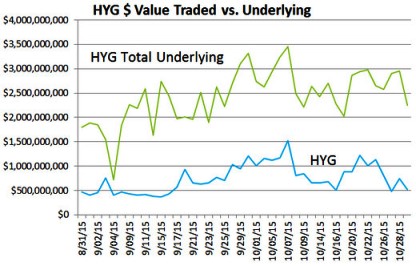
They’re calling it the “ETF bid” — the idea that corporate bond prices get juiced when passively managed funds have to buy them. It’s known to happen in thinly traded stocks in some instances. So it shouldn’t come as a surprise that thinly traded, idiosyncratic markets like high-yield bonds are seeing a similar effect. It’s the cautionary part of an otherwise pretty encouraging story: ETFs’ power to crack open hard-to-reach asset classes for more investors.

This week’s print Barron’s ETF Focus on the subject concludes that investors should be especially wary of selling passively managed bond funds when markets turn bearish — that’s often the best time to buy. And investors who buy these ETFs when markets feel rosy pay a premium for the service. Obviously, it’s best to avoid paying extra if possible.

Yes, it’s the same old advice, to be a contrarian investor. But ETFs are only growing in importance in the bond markets. The more heavily they are traded, the more investors have to pay attention to their pricing dynamics — and that’s true even for those who don’t use ETFs. If you haven’t read our Barron’s print column, one of the key findings comes from Goldman Sachs’ (GS) Charles P. Himmelberg and Lotfi Karoui. The duo estimate that a monthly rebalanced portfolio of bonds tracked by the iBoxx $ Liquid Investment Grade Index, the benchmark driving the $24.5 billion iBoxx $ Investment Grade Corporate Bond Fund (LQD), has beaten comparable non-indexed bonds by roughly 4.7%, or about 1% a year, since the beginning of 2009.

Great, right? Well, not always. Index bonds also appear to sink harder during bad times, as they did late last year.

In this vein, we wanted to point out a meticulous look at how this works in practice, from TF Market Advisors’ Peter Tchir. More…

State Street Introduces 2 New Corporate Bond ETFs Reply

By Benzinga.com

State Street’s STT -0.55% State Street Global Advisors unit, the second-largest U.S. ETF sponsor, will introduce two new bond ETFs on Tuesday.

The SPDR BofA Merrill Lynch Crossover Corporate Bond ETF will track an index that offers exposure to dollar-deonominated U.S.-issued BBB and BB-rated corporate debt. BBB is the lowest investment grade rating and BB is a non-investment grade rating.

Qualifying securities must have at least one year remaining term to maturity, a fixed coupon schedule and a minimum amount outstanding of $250 million. Original issue zero coupon bonds, 144a securities, both with and without registration rights, and pay-in-kind securities, including toggle notes, qualify for inclusion. Callable perpetual securities qualify provided they are at least one year from the first call date. Fixed-to-floating rate securities also qualify provided they are callable within the fixed rate period and are at least one year from the last call prior to the date the bond transitions from a fixed to a floating rate security, according to XOVR’s prospectus.

SSgA will also introduce the SPDR BofA Merrill Lynch Emerging Markets Corporate Bond ETF . Other ETF sponsors have already found success with emerging markets corporate bond ETFs, a fact that could either bode well for the SPDR BofA Merrill Lynch Emerging Markets Corporate ETF or indicate the ETF is late to the party.

The WisdomTree Emerging Markets Corporate Bond Fund EMCB +0.42% , which debuted in March, now has almost $60 million in assets under management. The iShares Emerging Markets Corporate Bond Fund (bats:CEMB), which debuted in April, has over $10 million in AUM.

Expense ratios were not included in the prospectus for either XOVR or EMCD.

WisdomTree Gets Wise With Corporate Bond ETF Reply

WisdomTree, the publicly traded New York-based ETF sponsor, today rolled out the market’s first broad-based emerging market corporate bond ETF, beating iShares and State Street Global Advisors to the punch.

The WisdomTree Emerging Markets Corporate Bond Fund (NasdaqGM: EMCB) is an actively managed portfolio consisting of dollar-denominated investment-grade corporate bonds from issuers in Asia, Latin America, Eastern Europe, Africa and the Middle East. the fund, which is listed on the Nasdaq exchange, has an annual expense ratio of 0.60 percent.

EMCB is an active fund that grants Legg Mason’s subsidiary Western Asset Management broad discretion in choosing credits. That process is crucial to keeping investors out of highly volatile countries and away from illiquid securities, Matthew Duda, EMCB’s portfolio manager, told IndexUniverse in a telephone interview.

See the full article here: