Archives: April , 2012

UK’s Abydos Hedge Fund Using Options to Prepare for Iran Strike

(Reuters) – Abydos Capital, a new hedge fund run by a former partner at one of London’s most high-profile oil investors, is worried about a potential military strike against Iran and plans to use options to protect his portfolio.

Jean-Louis Le Mee, Chief Investment Officer of Abydos, told Reuters he thinks there is a 25 to 50 percent chance of an Israeli strike against Iran’s nuclear capabilities, an act that would likely send stock markets tumbling and drive up oil prices, hitting hedge funds that hadn’t protected their portfolios.

Le Mee, one of the first hedge fund managers to discuss such a strategy, said he was planning to use options to profit from a spike in oil prices and a fall in equities via the S&P 500 index .SPX if Iran was attacked over its nuclear programme.

“There’s a high chance that something will happen either this summer in June/July or after the U.S. elections,” said Le Mee, whose former firm BlueGold made headlines in 2008 by calling the peak of the market. “If talks break down, then the Israelis could do something very quickly.

A typical hedging policy could see a fund buy call options, the right to buy at a certain price, on an asset it expects to rise, and buy put options, the right to sell at a predetermined price, on assets it expects to fall. Continue reading

State Street Begins Asset-Allocation ETFs in Active Push


State Street Corp. (STT), the second- largest manager of exchange-traded funds, opened three products that can spread money across a range of asset classes in a push into actively managed ETFs.

The funds will use tactical asset-allocation strategies and invest in ETFs including those run by State Street, James Ross, senior managing director of State Street Global Advisors, the Boston-based company’s money-management unit, said today at a conference in New York. The mix of underlying investments will include stocks, bonds, commodities and other asset classes.

“I can see active ETFs being a larger part of the ETF landscape,” Ross said. “We obviously plan to participate in that growing market.”

State Street, which introduced the industry’s oldest ETF in 1993, manages about $307 billion in the products, entirely in passive strategies. The firm’s active ETFs come about two months after Bill Gross became the most prominent fund manager to push into the industry. Gross’s Pimco Total Return Exchange-Traded Fund, which has beaten the bond market with a 3.3 percent return since it started on March 1, has gathered $540 million in assets.

Continue reading

Sponsors Scout Buying Options within SMAs


A little-used and relatively obscure investing strategy – buying options within a separately managed account – has made a bit of a stir in recent months, with a spike in product development talks between asset managers and platform sponsors, mostly for the strategy’s potential to address advisor and client concerns about market volatility.

The technique of using options in SMAs has been around for a while, primarily as a specialty aimed at generating returns through option-writing expertise, or to help clients with large concentrated positions hedge their portfolios. The new strain of product inquiries, however, is looking at how options might help advisors address a major concern of the last few years: lessening the shock and distress clients feel when the markets shimmy and shake in all directions.

“We’re seeing more demand in the last year or so, maybe even in a shorter timeframe,” says Patty Loepker, director of externally managed SMA and institutional products at Wells Fargo Advisors, who is chairing the Money Management Institute’s conference this week in Chicago. “More advisors are calling and asking for strategies, and we’re seeing more demand for managers that offer it.” Continue reading

Goldman ETF Strikes Gold in India

  Trading in Goldman Sachs Group Inc.’s gold ETF in India surged almost 11 fold, leading an advance in gold securities, as investors bought gold to mark the auspicious Hindu festival of Akshaya Tritiya.

Volumes in GS Gold BeEs, India’s biggest exchange-traded fund backed by gold, was 937,816 units on the National Stock Exchange of India Ltd. at 4:54 p.m. in Mumbai, up from 85,376 units yesterday and more than the 101,914 average daily volumes in the last six months through yesterday, according to data compiled by Bloomberg.

Gold demand in India, the world’s biggest importer, may climb as much as 25% to 15 metric tons on Akshaya this year, according to Rajesh Exports Ltd., the country’s biggest gold-jewelry exporter.

Assets held by local gold funds reached a record 98.9 billion rupees ($1.87 billion) at the end of March, according to the Association of Mutual Funds in India. GS Gold BeEs had assets worth 29.6 billion rupees (some $563 million (USD)) as of March 31, data from the association showed.

Trading in UTI-Gold Exchange Traded Fund climbed more than fivefold, while volumes in Reliance Gold ETF, the second-biggest fund, was up more than sixfold, data shows.

Does Size Really Matter? (with ETF Returns)

According to Benzinga.com’s ETF Professor, its not necessarily the size of the ETF, but the motion when it comes to investor returns.

From Benzinga’s April 23 edition:

“..There are plenty of instances in life when bigger is better. When it comes to exchange-traded products, bigger isn’t always associated with better [4]. At least when it comes to what should be investors’ primary consideration: Returns.

It has been documented that ETFs and ETNs with low average daily volume [5] and an assets under management number that may not be viewed as impressive by the so-called experts can outperform. In fact, all investing in an ETF with a bigger AUM total does is lead investors to a bigger fund, not larger returns [6].

Fortunately, a move away AUM and average daily volume as the primary determinants of an ETF’s worth is already under way.

“Some of the traders we talk to are using AUM and ADV a lot less now,” said Chris Hempstead, head of institutional sales and trading at WallachBeth Capital. “Some hedge funds using ETFs to hedge might use the larger ETFs because they just need short-term exposure, but buy-side traders are using AUM and ADV less and less.”

The statistics back up the assertion that bigger isn’t always better with ETFs. In an interview with Benzinga, Hempstead noted that in the case of the nine Select Sector SPDRs, all have been outperformed by a comparable fund of smaller stature on a year-to-date basis. Continue reading

Better Take a Peak at China’s PEK..Premium Merchandise

Courtesy of the ETF Professor at Benzinga.com

Following the March 22 debacle concerning the VelocityShares Daily 2x VIX Short-Term ETN (NYSE: TVIX  that saw the now infamous ETN tumble 30% in that one trading day, traders and investors predictably wondered what exchange-traded product could be next to fall victim to a similar scenario.

That scenario being an ETF or ETN trading at an elevated premium to its net asset or indicative value. One fund that has been noticed trading at elevated premium’s to its NAV is the Market Vectors China ETF (NYSE: PEK [6]) and this has been the case since the ETF debuted in October 2010.

What some investors may not understand is the reason why the Market Vectors China ETF has previously traded at premiums to its NAV that have been as high as 12%, sometimes a tad more. PEK is the only U.S.-listed ETF that offers investors exposure to China’s A shares market, but since foreign investors are limited in owning Chinese A shares directly, PEK uses swaps and derivatives instruments to accomplish its objectives.

Noteworthy is the fact that PEK’s premium has started to shrink, coinciding with news announced earlier this month that the China Securities Regulatory Commission boosted the quotas for qualified foreign institutional investors to $80 billion from $30 billion.

Chris Hempstead, head of ETF trading for New York-based execution firm WallachBeth Capital, talked about the implications increased access to China’s A shares for foreign investors may have on PEK in an exclusive interview with Benzinga on Friday.

Chris Hempstead, WallachBeth Capital

“PEK trading an elevated premium to its NAV in the past was not a function of it not being able to create and redeem shares as was the case with TVIX,” Hempstead said. “There are completely separate reasons why PEK’s NAV has been elevated compared to TVIX and some of the other products.”

Hempstead explained that it is the process by which PEK accesses China’s A shares market that has led to the high premium to its NAV in the past. Continue reading

China approves new yuan ETFs in Hong Kong


(Reuters) – Chinese regulators have started licensing domestic funds to create new yuan-denominated exchange-traded funds (ETFs) for sale in Hong Kong, hoping to attract fresh investors to use yuan they have accumulated offshore to invest in mainland markets.

Within two weeks of announcing a 50 billion yuan ($7.9 billion) increase in the quotas for the Renminbi Qualified Institutional Investor (RQFII) program, China’s market regulator has already issued licenses for the Hong Kong subsidiaries of some domestic fund management companies to create new funds, according to sources and media reports.

A source at one fund said the CSRC had given approval to create an index-linked ETF but said that permission from the Hong Kong Securities and Futures Commission (SFC) was still pending. The source said the CSRC had not yet specified how much of the new quota the fund would receive.

The 21st Century Business Herald, a prominent financial newspaper, quoted an anonymous fund manager as naming four companies as having received approval to launch index-tracking ETFs: Harvest Fund, China AMC, E Fund Management and CSOP Asset Management.

The report said the funds would track the CSI100 index .CSI100, the CSI300 index .CSI300, the FTSE Xinhua China A50 index .FTXIN9, and the MSCI China A Index .dMICNA0000P but did not specify which fund would track which index.

iShares to Introduce EM Corporate Bond ETF Thursday

Courtesy of Benzinga.com’s  “ETF Professor”–and distributed by Dow Jones MarketWatch..

By far the most prolific issuer of new ETFs in 2012, BlackRock’s BLK +1.83% iShares unit, the world’s largest ETF sponsor, will introduce another new bond ETF on Thursday when the iShares Emerging Markets Corporate Bond Fund (bats:CEMB) debuts.

The iShares Emerging markets Corporate Bond Fund will be the latest iShares offering to list on the BATS Exchange.

CEMB will track the Morningstar Emerging Markets Corporate Bond Index and feature dollar-denominate issues. Eligible individual securities must have a minimum outstanding face value of $500 million or more, and eligible issuers must have aggregate outstanding debt of $1 billion or more to be included in the index and a remaining maturity of 13 months or more at the time of rebalancing and a minimum of 36 months to maturity or greater at time of issuance, according to ETF Daily News.

While there are no ratings restrictions for the issues to be included in the index, the bonds must have at least one rating from Fitch, Moody’s or Standard & Poor’s. Continue reading

Don’t Cry For Me, Argentina…Argh! Re: ARGT

It remains to be seen whether Argentina’s nationalisation of YPF ends up in a military face-off with Spain (wouldn’t that be the black swan that nobody even thought of?!), but this coverage is courtesy of Zacks Research:

“…In order to play the Argentinean economy in basket form, investors have the FTSE Argentina 20 ETF ( ARGT ) from Global X. The fund hasn’t exactly caught on with investors, as the ETF has less than $5 million in assets and sees pretty wide bid ask spreads.

On the nationalization news, the Argentina ETF sank by 3.6%, pushing the ETF pretty close to its 52 week low. While many Argentinean stocks weren’t too heavily impacted by the news, it should be noted that YPF does make up the fourth biggest allocation in the South American ETF and this company plunged by 11% during market hours although it was up about 2.4% after hours.

Beyond this, it is also troubling that the two biggest sectors in ARGT are energy and basic materials. Given that Argentina has proven to be a proponent of nationalization in the energy space and that basic materials could suffer the same ‘national public interest’ fate, it doesn’t look good for the fund going forward.

In fact, these two sectors combine to make up nearly 45% of the total assets including four of the top ten holdings. Additionally, one has to wonder how much other energy companies will want to invest in Argentina after this debacle, possibly signaling a shift in policy by many oil firms that have operations in the nation.

“Going forward, you are going to see a severe retrenchment of external investors in looking at Argentina,” said Enrique Alvarez , head of Latin American research at IDEAglobal, in a Marketwatchinterview. When nationalism and expropriation “come back into the government lexicon, those are terms that have no fit whatsoever in the current, broader scheme of financial markets and of investments around the globe.”

Thanks to this report and the general uncertainty in this South American market, many investors may want to shy away from an Argentina stock purchase. If anything, ARGT could be an intriguing long term short candidate, or part of a pairs trade with other South America ETFs.

Continue reading

Diamonds Are A Girl’s Best Friend.. Inside an ETF??

As reported by ETF Trends (among others), diamonds could follow precious metals such as gold to be “commoditized” by the introduction of exchange traded funds based on this obscure market if regulators approve the products.

An ETF could be diamonds’ best friend or their worst enemy, based on your perspective.

Last month,  ETF provider IndexIQ  filed with the Securities and Exchange Commission to launch a physically backed diamond fund.

However, there are many challenges involved with launching diamond ETFs. Unlike gold, the gems are not uniform. There are many different types of diamonds, based on size, quality and other factors. And, unlike most commodities, there is no futures market for diamonds. Up-to-date diamond pricing is very inefficient, and those seeking to receive a more accurate market price on diamonds will have to subscribe to reputable sources.

A diamond ETF would most likely be backed by physical holdings, similar to the most prominent precious metals ETFs. DeBeers, the world’s largest diamond supplier, has received requests to back an ETF vehicle, but nothing has come of it.

Some advisors are already advising caution on a diamond ETF, even though it’s not clear whether such products will gain regulatory clearance. “Stay away until you know exactly how it works, and can be sure it’s acting like you think it will,” said Ron Rowland at Capital Cities Asset Management. It’s going to be a difficult market to create.”

AAPL Un-Buckling-Case Study ETF Correlation

According to TradersMag, during Q1 2012,  ETF volume as a percentage of total volume reported by major exchange fell to 16 percent from 19 percent (for all of 2011) because correlations between individual stocks and ETFs has declined. Once again, it appears to be a stock-picker’s market.

The same column in TM referenced a Credit Suisse reoprt that found that average correlation across the S&P 500 went as low as 13 percent in February. (It has since bounced back to around 40 percent.) In 2011, by contrast, correlation surpassed 80 percent in the fall and ended the year at 77 percent for December.

According to Credit Suisse analyst Ana Avramovic, ““If correlation is high, then macro fears tend to dominate, and ETFs are a great way to implement macro ideas since they give you exposure to an entire sector or theme with a single product. Naturally, as correlations come down, it makes sense that ETF activity would also come down.”

Industry sources suggest that while volumes in plain vanilla ETFs–those comprised of single-name stocks- may be declining, there has been an increased use of leveraged ETFs, and ETFs tied to commodities.  One trader says, “We have so many more sector products that are out there, and so many different ETFs that are coming out that drill down to minutiae so you can get very specialized exposure. “People are going to use that instead of going in to buy a single stock.”

Now,  let’s turn the page back a few weeks to the post that identified the ETFs with largest AAPL weightings. Now let’s look at the overall market averages vs. those ETFs and vs. AAPL.  No surprises, right?

From Russia With Love: RSX Iron Condor

Courtesy of WCI top gun Matt Buckley..For those loving Russia, here’s a market neutral thesis that capitalizes on volatility.

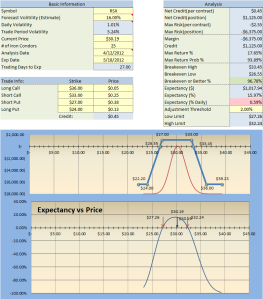
“RSX Implied Volatility is overpriced relative to its forecast volatility of 5.24% over the trade period. We are looking for possible price movement but for it to stay within its $27.00 to $33.00 price range until the exit of this trade.”

Tactic: Opening 25 RSX May 2012 Iron Condors (strikes [24/27/33/36]) for a $0.45 credit

Tactical Employment of Iron Condor:

  • Buying to Open 25 RSX May 2012 $36.00 Calls
  • Selling to Open 25 RSX May 2012 $33.00 Calls
  • Selling to Open 25 RSX May 2012 $27.00 Puts
  • Buying to Open 25 RSX May 2012 $24.00 Puts
  • Net Credit: $45.00 per Iron Condor for a total of $1125.00
  • Max Gain: $1125.00
  • Max Risk: -$255.00 per Iron Condor for a total risk of -$6375.00

European Platform to offer best price for ETFs


An exchange-traded fund platform service has been launched into the UK and European market to help IFAs and wealth managers ensure best execution when recommending clients invest in ETFs.

Laurie Pinto, chief executive of London-based securities research firm NSBO, said the service is being offered through a joint venture between NSBO and WallachBeth, a US inter-market broker.

Mr Pinto said the service, already popular in America, was important for the post-retail distribution review world as it aims to get the best price for ETFs.

He said: “In America each tranche of an ETF has to be put on an exchange, so you can track the price more easily. This does not happen in Europe.

“This puts the end investor at a major disadvantage. This service will aim to educate investors on getting the right price. The service of best execution is a big part of managing money.” Continue reading

NASDAQ New Rule: ETF Issuers Can Pay Market-Makers Quoting “Thinly-Traded” products


As duly noted by industry expert TABB Forum, ETFs with little-known or illiquid underlying securities are a hard sell without liquidity.  “Whether you loved or hated them, major exchange specialists (including this blogger) played a vital role to help nurture small listings, and the problem of how to incent liquidity provision is an ongoing industry debate. Without an extra incentive, market makers don’t consider it worth the risk..”

NASDAQ apparently understands this challenge. As reported by TABB, and in a rule filing submitted to the SEC, the exchange that will soon be home to Facebook proposes to put ETF issuers in the driver’s seat by facilitating issuer payments to market-makers in consideration for those traders quoting and trading those pesky, “hard-to-trade” aka “illiquid” ETF products that seem to trade by appointment only.

According to the TABB piece, “..The rule filing is waiting to be ‘noticed’ by the SEC, which will start turning the wheels of the rule filing and formal commentary process. If ultimately approved, the writing is on the wall for equities.There is little on the regulatory table at the moment to improve market quality, but prior success of a similar program abroad and political concern over how to improve the lot of smaller securities at least gives this proposal a decent chance of making it to the pilot…”

Not everyone fully agrees. At least one former ETF market-maker who was invited by NASDAQ to help formulate their new proposal believes it could open Pandora’s box (even if some think the Genie is already out of the bottle..) Continue reading

Covered Calls Vs. Selling Puts On The SPY

Courtesy of Seeking Alpha’s “Reel Ken”

We often hear about selling covered calls to generate additional income. We also hear about selling Puts to generate income. So the question becomes: Which is a better strategy?

The first step in answering this question is to understand that, from a performance perspective, they are two sides of the same coin. That is, if you owned, say 100 shares of the SPDR S&P 500 ETF (SPY) and sold a covered call with a strike of, say $140, in theory you would get a similar result by simply selling a put option with a strike of $140. Reality is a little different.

Let’s look at why this is so. SPY is currently trading at $139.79. The January 2013 $140 strike call sells for $7.99. If SPY closed at or above $140, I would make 21 cents on SPY and $7.99 on the covered call for a total of $8.20. However, SPY pays a quarterly dividend averaging about 66 cents, and the SPY shares would earn this dividend. There are three dividend events (June, September and December) totaling $1.97. So my total return would be $10.17 ($7.99 + $0.21 + $1.97).

In contrast, the $140 strike put sells for a credit of $10.15. If SPY closes at or above $140, this total credit is earned profit and compares favorably to the $10.17 combined return from the covered call. So, the covered call and sold put are about equal.

If SPY closed below $140, the equivalence stays intact, but I’ll leave it to the reader to do the math.

What about other option expiration dates? Continue reading

Benziga’s Best ETFs for Passover, Easter

     This weekend brings celebrations of two of the most important religious holidays in the world: Easter and Passover. And given the way stocks have acted this week, a time that is historically bullish for equities, it might be a good thing that U.S. equity markets are closed tomorrow in observance of the Good Friday holiday.

In the essence of not being all doom and gloom, there are some ETF and ETN opportunities with Easter/Passover ties worth considering at the moment. This list could prove particularly useful for both bulls and bears because we’ve mixed in valid long and short opportunities. So let’s get on with it, starting with the…iPath DJ-UBS Cocoa TR Sub-Index ETN NIB +0.62% 

Indeed the iPath DJ-UBS Cocoa TR Sub-Index ETN makes frequent appearances on any list of holiday-related ETFs/ETNs when the holiday involves above average chocolate consumption. So when the kids are enjoying their Easter baskets on Sunday, think about NIB. Down over 33% in the past year, the ETN may be a technical long at the moment as the chart is showing a double bottom formation.

Continue reading